
The concept of family today rests on multiple configurations, where parental origins (biological, legal, cultural) redefine the ties of filiation. Understanding contemporary family means first admitting that the unique model no longer exists: heterosexual couples, same-sex parents, blended families, single-parent families, or those resulting from assisted reproductive technology coexist within the same social framework.
Joint Anticipated Recognition: A Legal Tool Redefining Filiation
Before addressing the visible diversity of families, a recent legal mechanism deserves to be understood because it profoundly changes the way parental origins are established. The joint anticipated recognition allows, within the framework of assisted reproductive technology with a third-party donor carried out by a couple of women, to establish filiation regarding the non-birthing mother at birth, without resorting to an adoption procedure.
In practical terms, consent to the donation must be received by authentic deed before a notary, without the presence of third parties. This notarial act is not a mere formality: it legally establishes the link between the child and each of the two mothers. The child can then bear the name of one of the mothers, or both names combined according to specific rules.
This mechanism illustrates how law creates parenthood independently of biology. For the families involved, as detailed by the origins of parents according to Maman Double, the question is no longer about who is the “real” parent, but how the legal framework recognizes and protects each parental link.
Biological Origins and Right to Access: What Changes with Assisted Reproductive Technology with a Third-Party Donor

Assisted reproductive technology with a third-party donor raises a central question in today’s family: Can the child know their biological origins? The French reform has opened the possibility for individuals conceived by donation to access identifying information about the donor upon reaching adulthood.
This evolution concerns both heterosexual couples and couples of women or single women using assisted reproductive technology. The donor now consents, at the time of donation, to the future communication of their identity. This is not a right of filiation: the donor does not become a parent. Access to origins remains an informational process, not a family recomposition.
The distinction is fundamental: biological origin and legal parenthood do not overlap. A child born through assisted reproductive technology has parents (those who consented and who raise them) and, potentially, a donor whose identity they may come to know. These two realities coexist without competing in current law.
Cultural Diversity of Parents and Transmission of Family Values
Parental origins are not limited to the biological or legal. The cultural heritage of parents (language, religion, educational practices, relationship to work) shapes the family unit on a daily basis.
In families where parents come from different cultural backgrounds, several dynamics intersect:
- The choice of language spoken at home, which often determines the child’s relationship with each family branch and influences their educational orientation.
- The negotiation of educational values, particularly regarding the place of individual autonomy versus collective obligations, which varies significantly from one culture to another.
- The management of celebrations, rituals, and dietary practices, a concrete area where parental origins manifest and where children build their own identity.
This diversity does not mechanically produce conflict. It requires ongoing articulation, a process of adjustment that each family undertakes in its own way. Children then grow up with an expanded repertoire of references, which can serve as a resource in their social and professional lives.
Blended and Single-Parent Families: Variable Parental Links
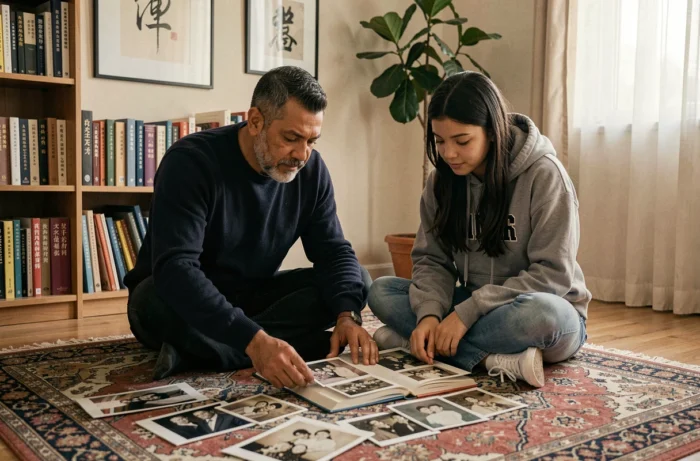
Family recomposition creates situations where multiple adults occupy parental roles without all being legally recognized as parents. The stepparent, for example, participates in the education, daily life, and decisions regarding the child, but has no automatic legal status.
In single-parent families, the question of origins arises differently. The absence of one of the two biological parents on a daily basis may be linked to separation, death, or a deliberate choice (assisted reproductive technology for a single woman). Each situation produces a distinct relationship to parenthood and origins.
What characterizes these configurations is the dissociation between the biological link, the legal link, and the social link. A family member can fulfill a parental role without either of the first two links. This reality compels a rethinking of what it means to “be a parent” beyond mere genetic transmission.
- The stepparent is involved in education without their own legal status, except through delegated parental authority.
- The absent biological parent can remain a strong identity reference for the child, even without regular contact.
- Grandparents or other extended family members sometimes play a leading educational role, especially when the isolated parent is working.
School Institutions and Parental Origins: A Silent Ground for Confrontation
School remains the primary social space where the diversity of families becomes visible. Administrative forms, parent meetings, school celebrations: each interaction reveals (or masks) the child’s family configuration.
Educational institutions are gradually adapting. The mention “parent 1 / parent 2” on some administrative forms has replaced “father / mother,” a technical change that reflects a deeper evolution. The school supports family diversity without always having the tools to understand it.
For children whose parental origins fall outside the majority framework, the issue is not abstract tolerance but concrete normalization. When a child from a same-sex, blended, or single-parent family no longer needs to explain their situation, it means the institution has integrated this diversity into its ordinary functioning.
Today’s family is defined less by a model than by the ability of its members to build stable ties within varied frameworks. The law evolves, social practices adjust, but it is in daily life, in educational choices and interactions with institutions, that the diversity of parental origins takes its concrete form.