
The American 8 is a discard game that pits 2 to 5 players against each other using a deck of 52 cards. The principle can be summed up in one line: play a card of the same color or value as the top card, or draw. Behind this simple mechanic lie tactical levers that separate the lucky player from the regular player.
The eight strategies that follow cover reading the opponent’s game, managing point risk, and the reasoned use of special cards.
1. Keep your 8 for the decisive moment

The 8 is the only card playable on any other card, and it allows you to change the requested color. Many players play their 8 as soon as they are stuck, out of reflex. This habit wastes the most versatile card in the game.
Keeping an 8 in reserve offers two concrete advantages. First, it serves as a safety net when the draw pile dwindles and options become scarce. Second, it allows you to regain the initiative when an opponent is nearing their last card by imposing a color they are unlikely to have.
Several recent English-language strategic guides on Crazy Eights confirm this approach: knowing the tips to win at American 8 starts with mastering the timing of playing the 8, not just its simple use.
2. Count the played colors to anticipate the opponent’s hand

French-language results describe the effects of special cards but rarely detail a method for reading the opponent’s game. The principle is accessible: observe which colors an opponent consistently draws and which they play effortlessly.
If a player draws every time the top card shows a club, they likely lack that color in their hand. Imposing that color (via an 8 or a transition card) forces them to draw again. Conversely, a player who plays hearts in succession likely has several: it’s better to break that streak by changing color as soon as possible.
3. Prioritize discarding high-point value cards

In scored variants of American 8, cards remaining in hand at the end of a round count against the player. Face cards (king, queen, jack) and the 8 itself weigh more heavily than low cards.
Discarding high-point value cards at the beginning of a round reduces risk in case of defeat. This logic, common in rummy, directly applies to American 8. Keeping a king “just in case” is costly if an opponent finishes before you.
The exception concerns high-value special cards (an Ace that makes someone draw, for example): their offensive power may justify keeping them longer.
4. Alternate colors rather than depleting a single color

A common reflex is to play all cards of the same color in succession. The problem: once that color is exhausted in your hand, you become vulnerable as soon as an opponent plays it again.
Maintaining at least two playable colors in your hand ensures greater flexibility. It’s better to play a spade when you still have three hearts than to exhaust your hearts and then rely on a single card or the draw pile.
5. Play the counter card to redirect penalties

The counter card rule exists in most variants: when an opponent forces you to draw (via a 2 or an Ace depending on the adopted rules), you can play the same card to transfer the penalty to the next player. The draws then accumulate.
Keeping a counter card in hand is not only for protection. It’s also an offensive tool: allowing the penalty to accumulate over several turns before one player ends up absorbing the entire draw can change the course of an entire round.
6. Announce “card” at the right moment to increase pressure

Most groups require announcing “card” (or “last”) when only one card remains in hand, under penalty. Beyond the obligation, this announcement changes the behavior at the table.
Opponents will try to block you by changing color or playing special cards. To limit this risk, play your second-to-last card on a turn that leaves you with an easy last card to play, ideally in the dominant color of the top card.
If it’s an opponent announcing “card,” here are the reflexes to adopt:
- Immediately change the color of the top card with an 8 if you have one
- Force them to draw with an Ace or a 2 if your variant allows it
- Pass the turn to another player with a jack or a 10 depending on your rules
7. Plan your color changes two turns ahead

Playing an 8 to change the color without knowing what you will play next is a common mistake. Before changing the color of the top card, ensure you have at least two playable cards in the new chosen color.
This two-turn planning allows you to maintain control. If you change to spades with an 8, then play a second spade on the next turn, you control the tempo. The opponent suffers your color instead of dictating theirs.
8. Adapt your strategy to the number of players at the table
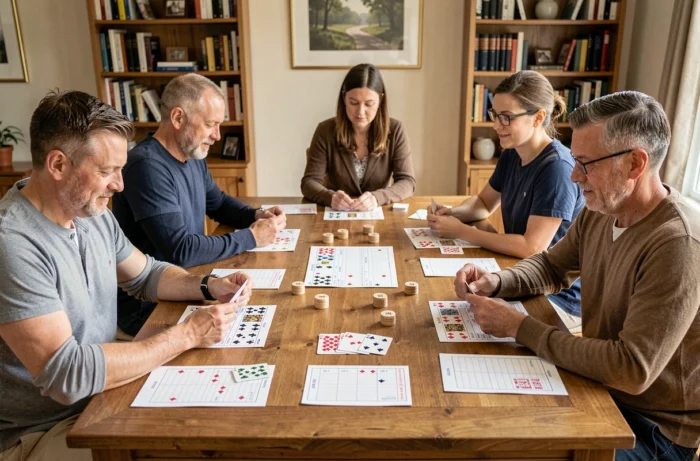
American 8 with two players and American 8 with five players are two different games tactically. With two players, each card played directly influences the opponent: reading their hand is more precise, and special cards always target the same player.
With four or five players, the dynamics change:
- Offensive special cards (forced draw, skip turn) become less targeted as they affect the next player, not necessarily the most threatening
- Color changes via the 8 are less predictable since more unknown hands redistribute the probabilities
- The draw pile depletes faster, making the management of remaining cards even more crucial
With two players, bet on aggression and special cards. From four players onward, patience and diversity of colors in hand take precedence over pure offense.