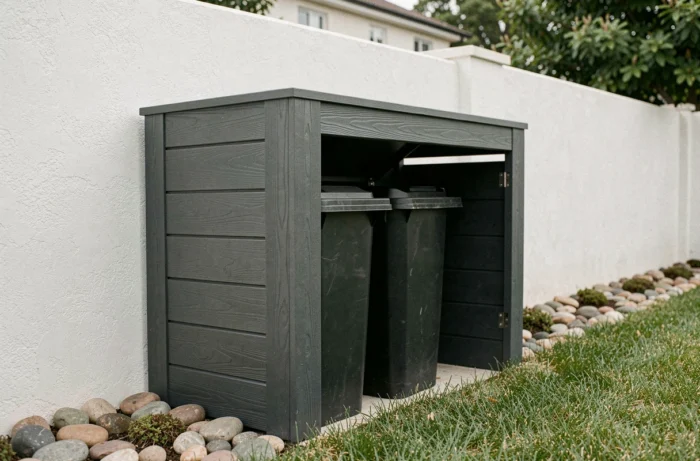
The collection bins lined up in front of a facade pose a problem that most homeowners are familiar with: odors in hot weather, degraded aesthetics, and difficult access on collection days. Choosing a suitable bin shelter requires balancing technical constraints (ventilation, materials, number of bins) with a often tight budget. At Brico Dépôt, the catalog covers several product families, but not all meet the same uses.
Ventilation and organic waste: the constraint that product sheets do not display
Since January 1, 2024, source separation of organic waste is mandatory for all French households, both in individual homes and in collective housing, according to Service-public.fr. A bin shelter that merely hides two gray and yellow bins is no longer sufficient.
The bio-bin or small food waste collection bin must remain easily accessible on a daily basis. A closed shelter without air circulation accelerates fermentation and odors, especially between May and September. Planning for real ventilation in the shelter has become a priority selection criterion.
In practical terms, this means checking for the presence of low and high ventilation grilles, or slatted openings on at least two sides. Fully enclosed models made of solid resin, common in DIY catalogs, pose a problem in this regard. Before validating a model, it is better to compare the ventilation area rather than just the visual aspect.
To examine the available references, consulting a bin shelter at Brico Dépôt allows you to identify models compatible with this ventilation constraint.
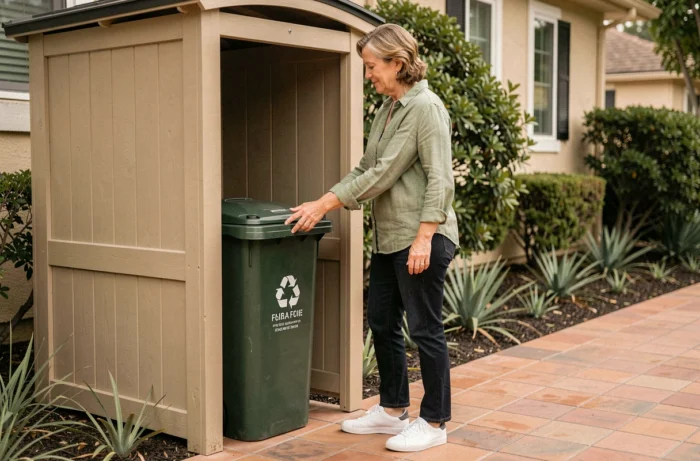
Wood, steel, or resin bin shelters: what the material changes in daily life
The choice of material is not just a matter of taste. Each family has direct consequences on maintenance, durability, and compliance with outdoor uses.
Treated autoclaved wood
Wood remains the most common material for bin shelters sold in DIY stores. Its main advantage is visual integration into a garden. However, a non-treated wood shelter every two to three years grays and warps.
Models made of treated autoclaved pine resist moisture better than raw fir, but no wood is fireproof. The Service-public site reminds us that for collective premises, the walls must be made of materials that are difficult to ignite. This reference, even if it targets co-ownership, provides useful guidance for a shelter backed against a facade.
Galvanized steel or corrugated sheet metal
Galvanized steel offers good weather resistance and requires almost no maintenance. Shelters made of corrugated sheet metal, sometimes offered with an integrated planter on top, combine robustness and discretion.
The weak point: internal condensation. Without proper ventilation, humidity stagnates and promotes bad odors. A steel shelter without ventilation grilles becomes an oven in summer.
Woven resin or resin panels
Resin does not rust, does not rot, and can be cleaned with a water jet. Woven resin models mimic rattan and integrate well on a terrace. In contrast, solid resin panels can give a less appealing plastic appearance.
Resin remains lightweight: on a wind-exposed site, a shelter not anchored to the ground risks tipping over. Checking the possibility of ground anchoring is part of the criteria not to be overlooked.
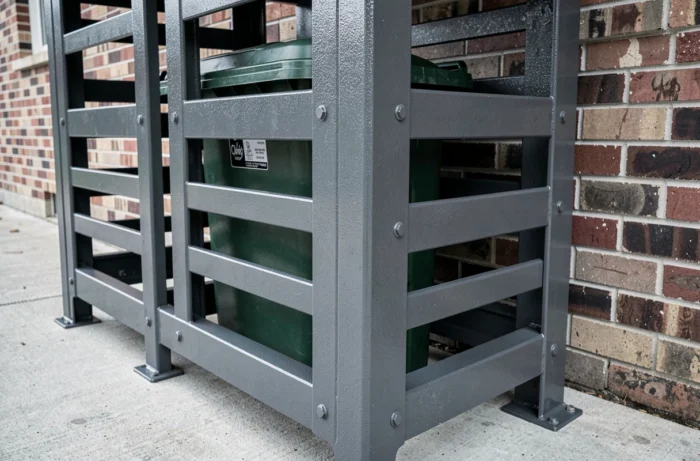
Size the bin shelter according to the actual number of bins
Most municipalities now impose sorting into three or four streams: household waste, recyclable packaging, glass (voluntary drop-off point or dedicated bin), and organic waste. A household may therefore need to store two to four containers, not counting a possible composter.
The shelters sold at Brico Dépôt mainly come in single, double, or triple versions. Choosing a model that is too tight forces you to leave one bin outside, which negates the investment’s purpose. A few points to check before purchase:
- The interior width must accommodate the bins with their lids open, not just closed. Some shelters are sized too tightly and prevent the lid from fully opening once the bin is inside.
- The depth must allow the bin on wheels to be pulled out without forcing. A few centimeters of clearance in front of the bin facilitates handling on collection days.
- The height under the roof must allow the bin with its lid raised to pass through. Standard collection bins often exceed one meter when opened.
A shelter that is too small turns every bin exit into a chore, and feedback from the field diverges on this point: the dimensions stated in the product sheet do not always account for the actual bulk in use.
Type of opening and daily access: the detail that makes the difference
The opening determines the practicality of the shelter on a daily basis. Three systems dominate the market:
- The front opening with hinged doors allows the bins to be fully removed. It requires clearance in front of the shelter equivalent to the depth of the bin.
- The top flap (liftable lid) allows for the deposit of bags without opening the doors, simplifying daily actions. However, taking the full bin out for collection remains less practical.
- The sliding opening is suitable for narrow spaces where a hinged door would be cumbersome, but the rails accumulate dirt and can jam over time.
The front opening combined with a top flap offers the best compromise between daily use and collection day. Models that offer both systems exist at Brico Dépôt, but they are fewer than the single-door versions.
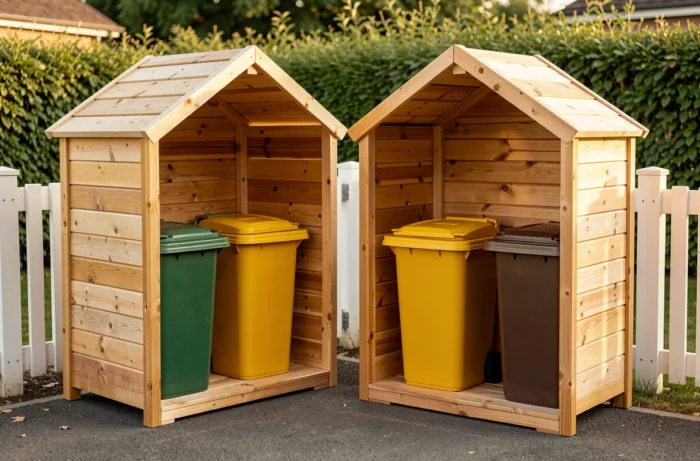
Prior declaration of works: the threshold to know
A bin shelter is an outdoor construction. Shelters with a footprint exceeding five square meters are subject to a prior declaration of works at the town hall. Below this threshold, no formalities are required in most municipalities, except in protected areas (historic monument perimeter, classified site).
Checking the local urban planning plan before installation avoids neighborhood disputes. Some regulations impose specific shades or materials on the street-facing facade, which may exclude a shelter made of raw sheet metal or colored resin.
The choice of a bin shelter at Brico Dépôt should be approached as a small outdoor development project rather than an impulsive purchase. Ventilation, actual sizing of the bins, type of opening, and compliance with the local PLU are the four criteria that separate a useful purchase from another burden in the garden.