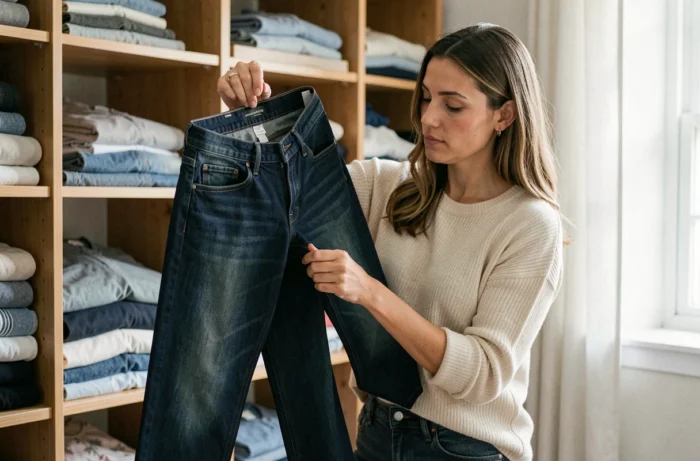
This gradual fading, combined with the mechanical wear of cotton fibers, is the main factor in the aging of the garment. Knowing when to replace a pair of jeans relies less on a fixed schedule and more on observing concrete signals related to the fabric, seams, and fit.
Denim Wear: Signals Indicating Replacement
Denim is a tightly woven cotton twill, whose durability depends on the weight of the fabric and the density of the warp yarn. When this fabric begins to thin, it becomes translucent in places, especially at the crotch, knees, and back pockets.
A pair of jeans with visibly sparse fibers at the crotch has exceeded its functional lifespan. Even without an apparent hole, a thinned denim no longer provides protection and does not maintain its fit. The friction area between the thighs is the first to give way, as it undergoes constant abrasion with each step.
The seams are the second reliable indicator. On a pair of jeans of decent quality, the polyester topstitching lasts longer than the fabric itself. When the side seams or the crotch begin to give way while the fabric is still intact, a repair is sufficient. When it’s the opposite (worn fabric, intact seams), replacement becomes the only sustainable option.
Find more fashion tips on Fourchette et Mascara to assess the condition of your denim pieces on a daily basis.

Washing Frequency of Jeans and Its Impact on Longevity
The frequency of washing has a direct effect on the longevity of denim. Each machine wash weakens the cotton fibers, dissolves some of the dye, and can distort the elastane present in stretch jeans.
Washing jeans every five to six uses represents a good compromise between hygiene and fabric preservation. Fans of raw denim go further by spacing washes several weeks, or even months, apart to encourage natural wear marks (the famous “fades”).
Washing Practices That Preserve Color and Fiber
- Turn the jeans inside out before each wash to limit abrasion of the dyed surface and protect the indigo color
- Use cold or lukewarm water, as heat accelerates dye bleeding and can cause shrinkage in 100% cotton denims
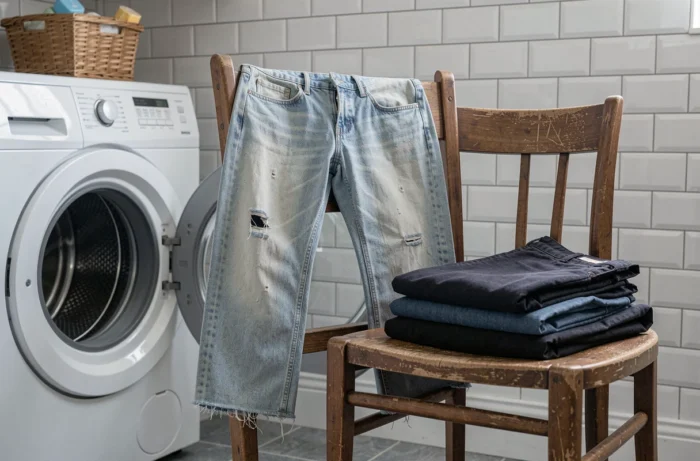
- Avoid the dryer: concentrated heat breaks fibers and reduces the elasticity of stretch jeans. Air drying, flat or on a hanger, preserves the original fit
- Opt for a gentle detergent without bleaching agents, which attack the dye and weaken the fabric over the long term
Between washes, airing the jeans outside for a night eliminates most odors without stressing the fibers. This simple method significantly extends the life of the garment.
Textile Repair Before Replacement: The Reflex to Adopt
A hole in the knee or a tear along a seam does not automatically justify throwing away a pair of jeans. Textile repair, particularly denim patching (or “darning”), can extend usage for several months or even years on fabric that is still generally sound.
In France, the Refashion repair bonus reduces the cost of a repair at a certified professional. The discount is deducted directly from the invoice, with no upfront payment required from the customer. This scheme covers holes, tears, and undone seams, but not size adjustment alterations.
Before replacing a damaged pair of jeans, checking eligibility for the bonus with a participating repairer often allows saving a piece where only a localized area has failed. A repaired pair of jeans at the crotch can last as long as a new one if the rest of the fabric retains its thickness.
When Repair Is No Longer Enough
The tipping point occurs when the thinning of the denim is widespread. If the fabric tears again a few weeks after a repair, or if several areas simultaneously show signs of transparency, the cotton has lost its structure. No patching can compensate for fabric that is generally exhausted.
Distorted Fit and Comfort: The Other Replacement Criterion for Jeans
Fabric wear is not the only valid reason. A pair of jeans that sags at the knees after a few hours of wear, whose waist has stretched to the point of no longer staying up without a belt, or whose thighs have lost all shape, has reached its structural limits.
Jeans containing elastane lose their elasticity faster than 100% cotton denims. The stretch gradually relaxes, and no wash fully restores the initial tension. On slim or skinny jeans, this loss of elasticity results in an unwanted “baggy” appearance, particularly noticeable at the knees and waist.
A rigid 100% cotton denim, on the other hand, wears in without distorting in the same way. It can soften and mark the body’s curves, but its structure remains stable longer. The choice of fabric composition at the time of purchase directly influences the duration before replacement.
- Stretch jeans (cotton + elastane): monitor the fit at the knees and waist, the first signs of loosening after several months of regular wear
- 100% cotton raw jeans: thinning of the fabric at the crotch remains the main signal, the fit lasts longer
- Industrially washed jeans: the initial chemical treatment already weakens the fibers, shortening the lifespan compared to a raw denim of equivalent weight
The European regulatory context is also evolving towards greater textile sustainability. The European Union adopted in 2024 a regulation on the eco-design of sustainable products and a directive on the right to repair, reinforcing the idea that extending the lifespan of a garment is a priority. Without setting a mandatory lifespan for jeans, this evolution pushes manufacturers to design more durable denims.
Replacing jeans when the fabric is generally worn out, when the fit no longer holds despite washing, or when successive repairs no longer satisfactorily extend usage: these three concrete criteria are better than an arbitrary schedule. Denim, due to its robustness, remains one of the most durable fabrics in everyday wardrobes, provided it is cared for between wears.