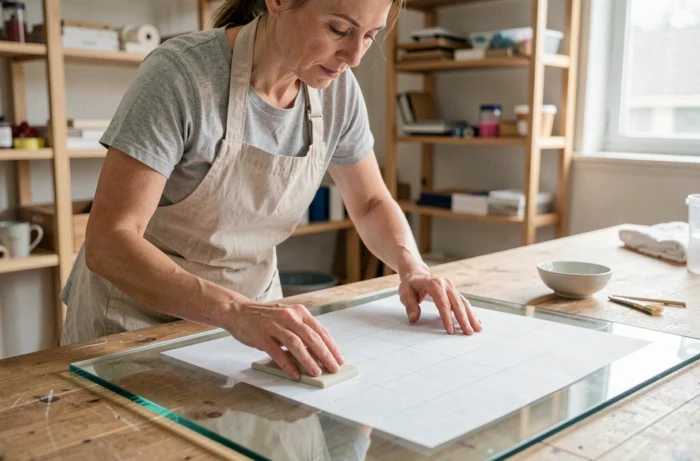
Placing a sheet of tracing paper on a window seems simple, until air bubbles form beneath the surface. Tracing paper, thin and sensitive to moisture, reacts to even the slightest excess of glue by wrinkling or trapping air. Achieving a clean adhesion on glass requires understanding why these two materials do not behave well together, and then adjusting each action accordingly.
Why tracing paper forms bubbles on glass
Glass is smooth, non-porous, and completely waterproof. Tracing paper, on the other hand, is fibrous and very reactive to the water contained in most liquid glues. When you apply a wet adhesive to such a thin sheet, it absorbs the liquid unevenly.
Areas that absorb faster swell slightly. Dry areas remain flat. This discrepancy creates air pockets between the paper and the glass surface. The result: bubbles appear even before you finish smoothing.
Another factor exacerbates the problem. A layer of glue that is too thick saturates the tracing paper and can cause ink migration if the paper is printed. A very thin and even layer limits these distortions, as confirmed by the glass decoration practices documented by STAK Properties.
Before looking for the right technique, you must choose the right product and measure precisely. If you are looking for a detailed guide on gluing tracing paper on glass, selecting the adhesive is the first step not to be overlooked.

Which adhesive to choose for a mark-free bond on glass
Have you ever noticed that classic white glue leaves whitish marks on glass once dry? This type of product is not designed for a non-porous surface. Glass absorbs nothing, so any excess remains visible.
Adhesives suitable for glass and thin paper
- Repositionable spray adhesive: it applies a uniform and very thin layer, reducing the risk of wrinkling. The tracing paper remains manipulable for a few seconds after application, allowing time to correct alignment issues.
- Methyl cellulose or wheat starch paste: used in the conservation of paper artworks, these adhesives have the advantage of being reversible. They age cleanly and allow for paper removal without damaging the glass, according to recommendations shared by Artisanat d’art.
- Matte medium for découpage: applied in a thin layer with a flat brush, it dries clear and offers good adhesion on smooth surfaces. Better suited than standard vinyl glue.
A permanent adhesive works for a definitive decorative project. For a setup you might want to remove someday, starch paste or methyl cellulose remains the safest choice.
Preparing the glass and tracing paper before application
The cleanliness of the glass surface directly determines the final result. A fingerprint, a grain of dust, or a residue from cleaning products creates a non-adhesion point. Air rushes in and forms a bubble.
Cleaning the glass without leaving residue
Use a mixture of water and isopropyl alcohol, then wipe with a lint-free cloth. Commercial window cleaners often contain polishing agents that leave an invisible greasy film. This film prevents the glue from adhering evenly.
After cleaning, avoid touching the bonding area with your fingers. Handle the glass by the edges.
Preparing the tracing paper
If your sheet of tracing paper is rolled or slightly curved, flatten it under a heavy book for a few hours. Paper that is not perfectly flat will trap air as soon as it contacts the glass.
Cut the tracing paper to exact dimensions before applying the glue. Adjusting with a cutter after gluing risks tearing paper that has become fragile due to the adhesive’s moisture.
Technique for applying tracing paper on glass without trapping air
The most reliable method is based on a simple principle: place the paper by one edge, then gradually fold it over to the opposite edge while pushing the air out in front of you.
Progressive application with a roller or squeegee
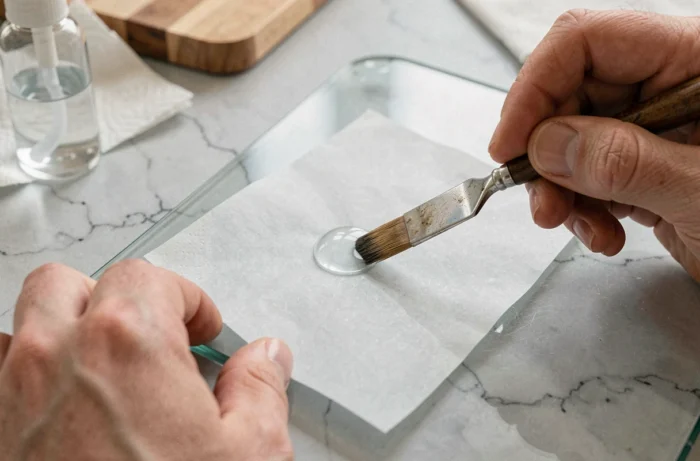
Apply the glue (spray or brush) on the glass, not on the tracing paper. The tracing paper is too thin to withstand handling once moistened. Place one edge of the tracing paper on the glass, then use a soft squeegee or rubber roller to smooth from the center towards the outer edges.
Advance in strips of a few centimeters, without rushing. Each pass of the squeegee pushes the air towards the areas that have not yet been glued. If a bubble forms despite everything, gently lift the paper up to the bubble (as long as the glue is still wet) and re-squeegee.
Managing edges and fragile areas
The edges of the tracing paper are the first to peel off if the adhesive layer is insufficient there. Apply a fine line of additional glue along the edges after the main application. Smooth immediately with your finger or a damp cloth to avoid any visible bulge.
In areas close to corners, the squeegee may mark the paper. Prefer a slightly damp microfiber cloth to smooth these spots without scratching the tracing paper.
Avoiding defects after drying: condensation and peeling
Even if the application seems perfect, the result can degrade in the days that follow. Condensation and temperature variations pose a risk distinct from initial bubbles. On a sun-exposed window or in a humid room, water condenses between the glass and the paper.
This phenomenon can cause the tracing paper to adhere irreversibly in some areas while peeling away in others. The Canadian Conservation Institute and the Northeast Document Conservation Center also advise against prolonged direct contact between paper and glazing for this reason.
For a decorative project exposed to light, apply a clear matte varnish over the tracing paper once the glue is dry. This film protects the paper from ambient moisture and stabilizes the whole.
If the gluing is intended for a window pane, consider placing the tracing paper between two sheets of glass rather than on the surface. This approach eliminates direct contact with humid air and removes the risk of peeling due to condensation.
A successful bond depends more on preparation than on the final gesture. A perfectly clean surface, suitable adhesive in a thin layer, and progressive application from one edge: these three steps resolve the vast majority of bubble problems on glass.