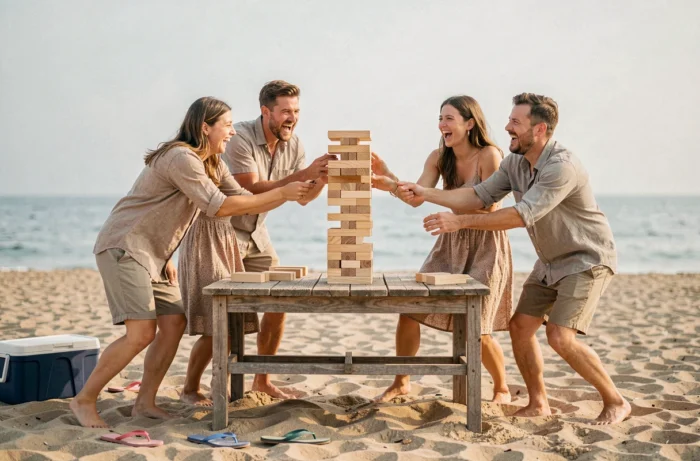
Organizing an afternoon on the sand among adults requires choosing activities that take into account the available space, local regulations, and the group’s energy level. Not all beach games for adults are created equal: some require bulky equipment, others work with what you have in a bag, and a few can quickly become awkward for neighboring towels.
Local regulations and terrain constraints before playing
Municipal regulations vary from one municipality to another and may restrict ball games, designate specific areas, or prohibit certain activities at specific times. On monitored beaches, markings separate swimmers from boats and water sports, which reduces the actual usable area for a match.
On a tidal beach, a field that seems wide at the start of a game can shrink by half in less than an hour. Games requiring fixed setups are poorly suited to rising tide slots. Prioritizing mobile activities that are easy to move helps avoid getting your feet wet in the middle of a set.
Occasional health restrictions should also be checked. In 2026, local swimming closures were decided due to cyanobacteria blooms. Games involving immersion (water relays, wave races) may then be discouraged. Consulting the posted guidelines at the beach entrance remains the most reliable reflex.
To explore a dedicated catalog, beach games on Joker Amusement cover several formats suitable for adult groups.
Beach games with little or no equipment: focus on simplicity
Equipment forgotten in the trunk of the car or a deflated ball after an hour are the two classic reasons why a group ends up doing nothing. Games that require little or no equipment have a direct practical advantage.
Beach version of the beret
Two teams, an object placed in the center (a flip-flop, a hat, an empty bottle), and a leader who calls a number. The player called in each team must grab the object and return to their camp without being touched. The “wet” version replaces the dry object with a water-soaked sponge, which adds an enjoyable comedic factor.
Tug of war on sand
The soft sand makes the exercise significantly more physical than on grass. A rope, two teams, a line drawn at their feet. The resistance of the ground transforms this classic into an intense activity that exhausts a group in just a few rounds. The advantage: setup takes thirty seconds and the rope fits in a bag.
Ambient card games
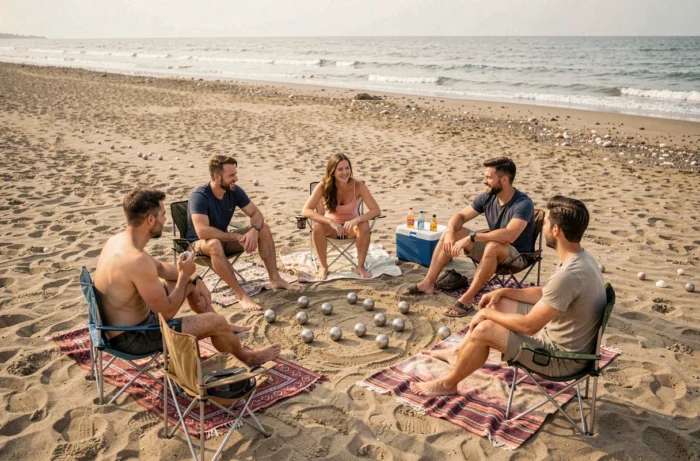
Compact card games remain a safe bet for mixed groups. Pocket editions of role-playing games, bluff games, or word association games work on a towel, are not afraid of the wind if you pin down the deck, and adapt to groups of four to ten players. The absence of a board or fragile pieces is a determining factor outdoors.
Ball and racket games on sand: choose according to space
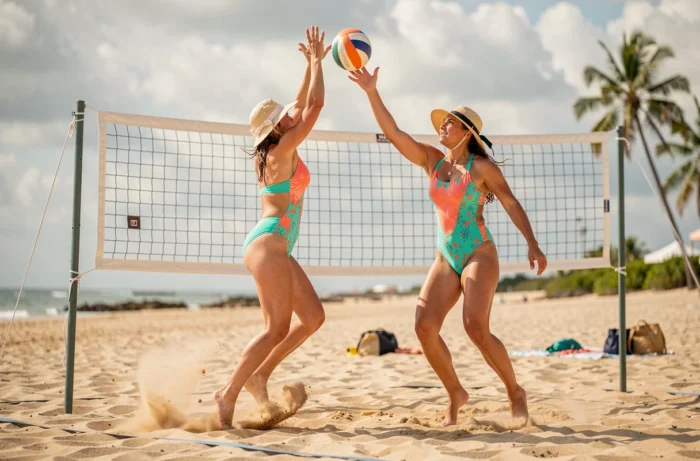
Beach volleyball and beach tennis dominate the usual suggestions, but they raise a rarely addressed question: the actual space you have. A beach volleyball net requires a cleared rectangle of about nine meters by eighteen, plus the back zones. On a crowded beach in summer, this space does not always exist.
Beach ball (wooden rackets and rubber ball) takes up much less space and requires neither net nor markings. Two players can exchange face-to-face in a corridor of a few meters. For four to six people, forming a circle and counting exchanges without dropping the ball creates a cooperative challenge that increases in intensity.
- Beach ball: suitable for busy beaches, requires two rackets and a ball, playable by two or in a circle
- Frisbee: ideal for wide and sparsely populated beaches, requires distance and remains mobile
- Beach volleyball: requires a net, a flat and cleared field, suitable for beaches with marked sports areas
- Spikeball: four players around a small trampoline, reduced footprint, but the bounce on soft sand changes the game
Local recommendations remind that a ball game should remain away from passage areas and walkers. Setting up your field at the top of the beach, away from the water, limits neighborhood conflicts.
Water games among adults: adapt the format to the day’s conditions
Bucket relays, splash races, or wet sponge challenges add a refreshing aspect that dry sand games do not offer. However, they assume that swimming is allowed and that water quality permits it.
A short format works better than a long challenge. Three to five relay rounds with a pierced bucket, for example, create a peak of energy without exhausting the group. Short and intense water games are better suited for adults than elaborate courses.
For days when access to water is restricted, the “wet t-shirt” (putting on a wet t-shirt as quickly as possible before running to a marker) uses very little water and generates a high level of competition. Filling a few bottles is enough as a reserve.
Building a rotation of games rather than a fixed schedule
A group of six to ten adults will not maintain the same level of attention on a single activity for two hours. Alternating a physical game (tug of war, beach ball) with a static game (ambient cards, riddles) helps manage differences in fitness and motivation.
- First hour: ball or racket game while energy is high
- Mid-afternoon: card game or role-playing game in the shade
- End of the day: water relay or wet beret to re-energize the group before leaving
Planning three different games covers the majority of scenarios: strong wind, rising tide, group fatigue, crowded beach. Each activity can be launched or abandoned in a few minutes without frustration.
The final choice depends less on the game itself than on the available terrain and the regulations posted that day. Checking the information boards at the beach entrance remains the most useful gesture before pulling out the equipment from the bag.