
The digital divide refers to the inequalities in access, equipment, and mastery of information and communication technologies. In France, despite a fiber coverage rate close to 95% of connectable premises by early 2026, thousands of households remain without a reliable connection. The gap is not only reduced by laying cables: it persists through economic, geographical, and social mechanisms that public policies struggle to address simultaneously.
The last mile problem in fiber zones
Most analyses of the digital divide contrast rural areas with urban areas. This perspective obscures a more recent phenomenon: non-connection pockets persist in the city center. In Toulouse, Dreux, or other urban areas, some homes remain connected via ADSL while the neighboring district has fiber.
The explanation lies in the deployment model. Operators deploy fiber in sections, starting with dense and recent residential areas that are more profitable. When the connection involves work in private areas (building risers, facade passage), the project is postponed or abandoned due to lack of immediate profitability.
This logic produces a counterintuitive result: national coverage progresses while micro-white zones persist in cities that are otherwise considered covered. The indicator of 95% of connectable premises says nothing about the reality experienced by the residents of these forgotten buildings. As detailed in the article on Votre Journal, these local disparities fuel a sense of exclusion that is difficult to quantify in national statistics.

France Very High Speed Plan: a postponed schedule that prolongs access inequalities
The France Very High Speed Plan, launched in 2013, aimed for the generalization of fiber by 2025. This goal has been officially postponed to 2030. At the same time, the gradual shutdown of the copper network (ADSL) is also scheduled for 2030.
This dual timeline creates a risky transition period. Households lose their ADSL connection before being connected to fiber. For these households, the only alternative remains the mobile network (fixed 4G) or satellite solutions like Starlink, whose monthly cost far exceeds that of a standard fiber subscription.
Rural fiber and a weakened economic model
In rural areas, deployment relies on public initiative networks (RIP) funded by local authorities. Several dozen local authorities have called on Arcep and the presidency to address the economic fragility of this model. The cost of connecting a household in low-density areas is significantly higher than in urban areas, and operating revenues do not always compensate for the investment.
The postponement to 2030 does not just delay the deadline; it increases the overall cost: maintaining two networks in parallel (copper and fiber) for an additional five years mobilizes resources that neither operators nor local authorities initially budgeted.
Illiteracy and digital skills: the invisible divide
Having a connection is not enough. Illiteracy, meaning the difficulty or inability to use digital tools in everyday life, affects a significant portion of the French population. Several factors combine:
- Age remains the primary determinant: people aged 55 to 74 use the Internet significantly less than those aged 16-24, with a gap of about 16 points according to the OECD.
- Educational level widens the gap: individuals with a high level of education are about 15 points above those with a low level of training in terms of regular use.
- Income plays a direct role: the gap between the most modest households and the wealthiest reaches about 12 points regarding regular Internet use.
These three variables combine. An elderly person, with low education and low income, accumulates obstacles. The dematerialization of public services (taxes, health insurance, Pôle emploi) then turns digital access into an administrative barrier.
Digital skills and real autonomy
Knowing how to turn on a computer and open a browser is not a sufficient skill. Creating an account, managing passwords, identifying a fraudulent email, filling out an online form: each of these actions requires a foundation of knowledge that public support programs struggle to transmit on a large scale.
Digital workshops exist in many municipalities, often run by volunteers. Their effectiveness depends on the regularity of attendance and adaptation to the real needs of participants, ranging from getting to grips with a smartphone to understanding dematerialized administrative procedures.
Digital divide and territories: why national solutions are not enough
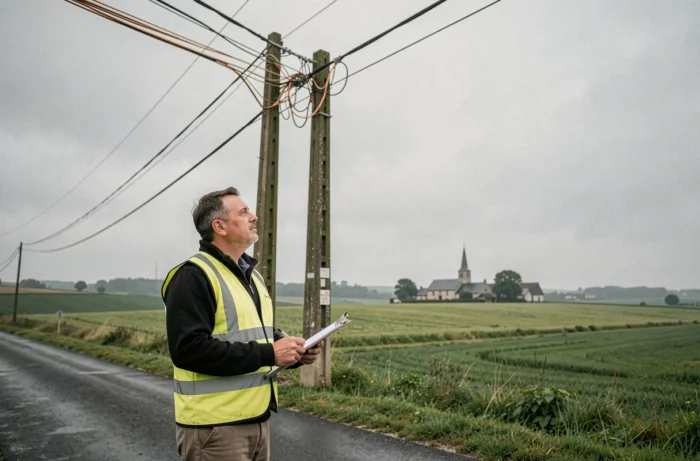
National policies set coverage goals and budget envelopes. The implementation, however, depends on very variable local realities. A department like Seine-Saint-Denis does not face the same obstacles as a canton in Cantal: in the first case, density complicates roadwork; in the second, low density makes connections unprofitable for private operators.
The digital divide in France is not a unique problem but a layering of distinct issues depending on the territories. Rural white zones, unconnected urban buildings, priority neighborhoods lacking individual equipment, and overseas territories each fall under different logics.
This fragmentation explains why no isolated measure, whether it be fiber deployment, equipment assistance, or digital training, can resolve all inequalities. Sustainable reduction of the digital divide requires articulating infrastructure, human support, and local adaptation, three areas that rarely progress at the same pace.