
Every week, new models arrive at dealerships, tax regulations change, and onboard technologies advance at a pace that even enthusiasts struggle to keep up with. For those looking to buy, maintain, or simply understand their car, automotive news has become a shifting landscape where yesterday’s benchmarks are no longer relevant.
CO2 penalty and weight penalty in 2026: what car enthusiasts really pay
Have you ever configured an SUV or a sports coupe online, only to discover an additional cost of several thousand euros at the summary stage? That extra cost is the penalty. And in 2026, it hits harder and earlier.
The CO2 penalty kicks in at 108 g/km, down from 113 g/km the previous year. In practical terms, family sedans that flew under the radar a year ago are now taxed. The weight penalty applies from 1,500 kg instead of 1,600 kg. This directly affects compact SUVs, well-equipped station wagons, and a good portion of plug-in hybrids whose batteries add weight to the vehicle.
For an enthusiast torn between a thermal sports car and a heavier hybrid version, the calculation is no longer straightforward. The hybrid consumes less on a daily basis, but its weight can trigger a penalty that the lighter thermal version avoids. A simple engine comparison is no longer sufficient: one must cross-reference CO2 emissions, curb weight, and total budget before signing.
Car enthusiasts who follow the news on Media Libre’s automotive media regularly find analyses on these tax developments and their impact on vehicle choice.
Tighter technical inspection: critical failure and unresolved recalls
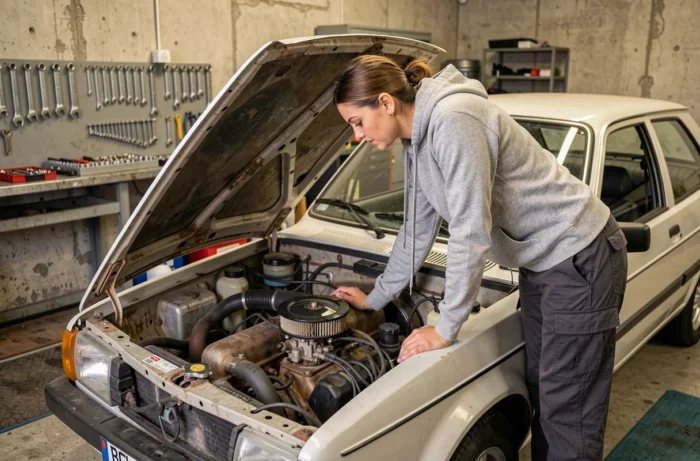
The technical inspection is no longer limited to checking brakes and lights. Since the update of the reference framework, an unresolved manufacturer recall can be classified as a critical failure. The consequence is direct: the vehicle cannot circulate starting the day after the inspection until the repair and re-inspection have been completed.
Why this tightening? Manufacturer recalls often involve safety-related parts (airbags, braking systems, electrical circuits). Ignoring a recall notice means driving with a defect identified by the manufacturer itself. The new framework makes this choice much more costly in terms of time and administrative burdens.
Before going for the inspection, a simple check can help avoid unpleasant surprises:
- Check the manufacturer’s website or the dedicated app with your chassis number (VIN) to see if a recall is ongoing for your model.
- Keep the workshop receipt if the recall has already been addressed, as the inspector may request it.
- For vehicles over twenty years old, old recalls remain in the database: a used model may carry a recall that was never addressed by the previous owner.
This point is rarely anticipated when buying used. Checking the recall history is now part of the reflexes to have before signing, just like the maintenance log.
Electric vs. thermal: where does the French car fleet really stand
The new registration figures give the impression of a rapid shift towards electric vehicles. The reality of the rolling stock tells a different story.
Nearly one in five new registrations concerns an electric vehicle. This is a notable increase. Meanwhile, owners of thermal vehicles are extending the lifespan of their cars. The result: the total fleet evolves slowly, and the majority of vehicles on the road remain thermal.
For a buyer, this situation creates a practical paradox. The charging network is improving (the latest figures indicate millions of charging sessions per quarter in France), but coverage remains uneven across regions. Buying electric in a densely populated urban area with a charging point at home or work is convenient. In rural areas, the calculation changes.

The other often underestimated factor is the repairability of electric vehicles. A recent European regulation aims to improve access to spare parts and technical data for EVs for independent garages. Today, a battery or electronic management system repair is often reserved for the manufacturer’s network, with corresponding delays and costs.
Car reviews and practical advice: how to read a car review
A review published in a car magazine or on a specialized site follows a codified structure. Knowing how to decode it helps distinguish useful information from subjective impressions.
The technical sheet summarizes measurable data: power, torque, weight, trunk volume, standardized consumption. These figures allow for comparison of two models on an equal basis. Real consumption, however, depends on the tester’s route. A test conducted on the highway at 130 km/h will yield very different consumption from a mixed route.
- Check if the review mentions the test conditions (temperature, type of road, load). The more detailed they are, the more useful the result.
- Braking and acceleration measurements taken with an instrument (like Vbox or Dragy) are worth more than a feeling behind the wheel.
- A review that rates comfort on a bad road without specifying the tire profile or wheel size omits a determining parameter.
- Always compare at least three sources of reviews before forming an opinion on a model that interests you.
Buying guides generally cross-reference these data with the list price, current discounts, and estimated maintenance costs. Good car advice relies on verifiable data, not on superlatives.
Automotive news in 2026 is shaped as much in showrooms as in legislative texts and tax scales. Keeping an eye on penalty thresholds, technical inspection rules, and the real-world conditions of electric vehicle usage helps avoid unexpected expenses. The most useful approach for an enthusiast is to align their desires with factual data, model by model, before each purchasing decision.