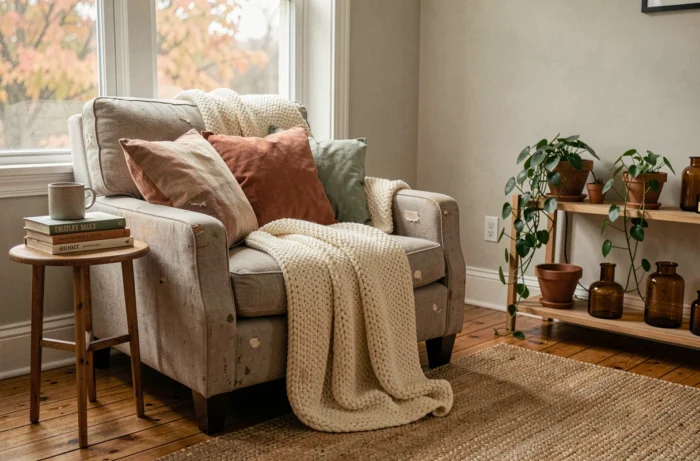
A room where one feels good doesn’t depend on an extravagant decor budget. It relies on a few concrete choices of materials, light, and layout that, when combined, change the perception of an entire space. Transforming your home into a cocoon means working on what the skin, the eye, and the ear perceive as soon as you cross the threshold.
Cocooning all year round: adapting materials for each season
Most decor advice associates cocooning with winter, thick throws, and candles. This seasonal view overlooks a strong trend: cocooning is now practiced all year round, including in summer, with materials like washed linen, rattan, or waffle cotton.
Why this change? Because comfort does not depend on the outside temperature. A sofa covered in linen in sandy tones provides the same enveloping sensation as a boucle wool throw, without the unnecessary heat of July.
The principle is simple: plan for two textile “wardrobes” for your interior. In cooler seasons, bring out the corduroy cushion covers and opaque curtains. In fine weather, switch to cotton gauze sheers and raw linen cushions. The sofa remains the same, but the atmosphere changes completely. To deepen your research on interior design, the site medialibre.fr gathers numerous ideas categorized by room and style.

Soft light in the living room: layer sources instead of relying solely on the ceiling light
Have you noticed that a living room lit by a single ceiling light seems cold, even when well-furnished? This is because a single source creates flat light, without depth or shadow areas. The eye has nothing to explore.
Three levels of light are enough to transform a living room: ambient lighting (floor lamp with a fabric shade), functional lighting (reading lamp near the sofa), and accent lighting (string lights or candles).
Specifically, place your floor lamp behind or next to the main seating area, directed towards the ceiling or wall for an indirect effect. Add an adjustable reading lamp on an articulated arm, useful for reading without straining your eyes. Finish with one or two candles on the coffee table.
- Floor lamp with a light fabric shade: it diffuses light upwards and creates a soft halo on the wall, visually enlarging the room
- Adjustable reading lamp near the sofa: it replaces the ceiling light for evening activities and reduces eye strain
- Candles or small lamps on the coffee table: they add a low light point that anchors the living space in an intimate atmosphere
Turn off the ceiling light. Turn on these three sources. The difference is noticeable in seconds.
Shades and colors of a cocoon interior: the trap of all neutrals
Beige, ecru, greige: the “cocooning” palettes found everywhere look alike. The result is often bland. A cocoon needs at least one character color for the eye to have an anchor point.
Japandi, this crossover between Japanese minimalism and Scandinavian design, works precisely on this principle. The background remains neutral (off-white, light wood), but a deep sage green cushion or a terracotta vase introduces a soft break that gives character to the room.
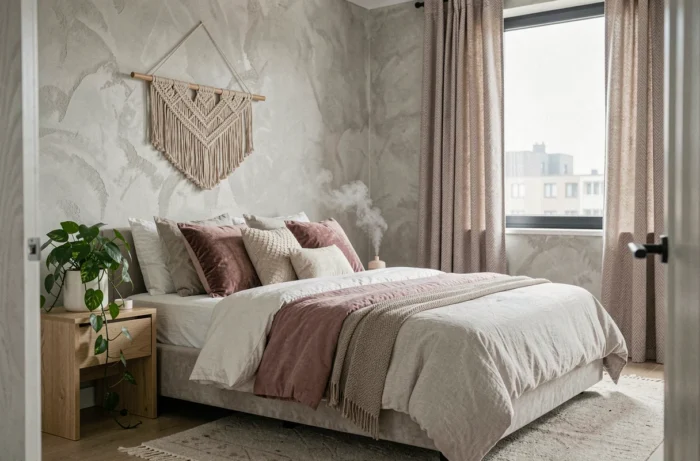
The warm Mid-Century style, very present in recent collections from major brands, pushes this logic further with mustard, rust, or duck blue shades on a piece of furniture or a wall. The trick is to limit the strong color to one element per visual area. A mustard armchair in the living room, a terracotta bed linen in the bedroom: no more.
Testing a color without commitment
Before repainting an entire wall, start with a cushion or throw in the desired shade. Live with it for a week. If the color bores you, the cushion can be replaced. If you like it, move on to a larger element (curtain, duvet cover). This gradual test avoids costly regrets.
Cocooning bedroom: what really matters for sleep
The bedroom is the room where the cocoon effect has the most measurable impact because it directly affects sleep quality. Two parameters matter more than wall decoration: the quality of the bedding and darkness.
A cotton sheet with a sufficiently dense weight (often called “percale”) provides a feeling of freshness in summer and softness in winter. A sheet that is too thin gives a cold impression, even under a thick duvet. Investing in bedding rather than decorative frames radically changes perceived comfort.
For darkness, blackout curtains lined with a sheer offer the best compromise. The sheer filters light during the day without darkening the room, and the blackout curtain blocks outside light at bedtime.
- Percale cotton or washed linen bedding: prioritize a dense weight for a lasting enveloping touch
- Blackout curtains lined with a sheer: they allow for two lighting atmospheres in the same room without changing the setup
- Rug at the foot of the bed: the contact of bare feet with a cold floor upon waking immediately breaks the cocoon feeling; a short-pile rug solves this problem
Reducing noise in the bedroom
Textiles absorb sound much better than bare walls. A thick rug, heavy curtains, and cushions on the bed reduce sound reverberation. In an old apartment with hardwood floors, this effect is particularly noticeable.
The cocoon is not a fixed aesthetic. It is a combination of practical decisions (materials, light sources, a touch of color, proper bedding) that readjust over the seasons and desires. Each room deserves its own dosage, without trying to standardize everything.