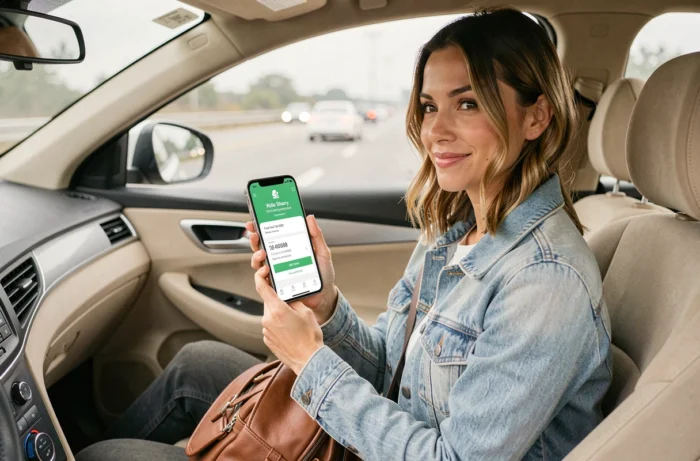
BlaBlaCar has gradually eliminated all possibilities for cash payments between passengers and drivers. All transactions now go through the platform, which acts as a financial intermediary between the two parties. This operation, often summarized by the term “online payment,” actually encompasses several mechanisms that deserve to be detailed, particularly the public systems that modify the amount actually paid or received.
Escrow and financial flow: what happens between booking and payment
When a passenger books a ride on BlaBlaCar, the amount charged does not go directly to the driver. The sum is held by the platform for the entire duration of the trip, according to an escrow mechanism.
The driver only receives their payment after the trip is confirmed. This delay protects the passenger in case of cancellation or dispute and ensures that the driver has indeed received the payment before departure.
Several details of this process remain unclear in most available guides. The choice of payment method on the driver’s side (traditional bank transfer or BlaBlaCar internal balance) affects the speed of the transfer. The details on blablacar payment passenger on Mister Bike clarify these differences in timing, which vary depending on the chosen option.
BlaBlaCar commission deducted from each booking: what the passenger really pays
The price displayed in the ad is not the one set by the driver. BlaBlaCar adds service fees to the amount requested by the driver. These fees, deducted from the passenger’s side, represent a significant portion of the final price.
The driver, on the other hand, only receives the contribution to the costs they defined, without any direct commission deducted from their share. In contrast, the platform captures the difference between what the passenger pays and what the driver receives. The passenger always pays more than what the driver receives.
This mechanism creates a gap that is sometimes misunderstood. A driver who sets a low price may be surprised to see a significantly higher fare on the passenger’s side. Conversely, a passenger comparing the cost of carpooling to the price of a train ticket must factor in these service fees in their calculation.
BlaBlaBono and carpooling bonuses: systems that modify the real amount
Since the implementation of energy savings certificates applied to carpooling, BlaBlaCar has integrated bonus mechanisms that change the game for both parties.
- On the passenger side, a system called BlaBlaBono automatically applies a discount of 15% off the price, capped at 4 euros per trip, with no promotional code to enter.
- On the driver side, a bonus of +15% on the amounts paid by passengers is added directly in the app.
- During the summer promotion of 2026, the passenger discount temporarily reached 30%, capped at 8 euros per trip, before returning to the standard rate after August 31, 2026.
These amounts do not pass through the passenger themselves. They are funded by public energy efficiency programs and paid through the platform. The total income received by the driver thus exceeds the simple contribution to costs paid by the passenger, which is almost systematically omitted in usual content about BlaBlaCar payments.
Concrete impact on a typical trip
On an average trip, the combination of the passenger discount and the driver bonus significantly alters the economic equation of carpooling. The passenger pays less than the displayed price, while the driver receives more than the initial contribution. The platform, however, retains its service fees intact.
This triple flow (passenger, driver, public subsidy) makes calculating the “true price” of a BlaBlaCar ride less transparent than it seems.
Cancellation and passenger refund: the rules governing the return of funds
The refund for a canceled booking depends on when the cancellation occurs in relation to the scheduled departure time. The later the cancellation, the lower the refunded amount.
- A sufficiently early cancellation entitles the passenger to a full refund, including service fees.
- A cancellation close to departure results in a partial refund or none at all, depending on the conditions displayed at the time of booking.
- If the driver cancels, the passenger is fully refunded, regardless of the timing.
The refund can take the form of a credit on the passenger’s BlaBlaCar balance or a return to the credit card used. The choice is not always explicit at the time of booking, which generates recurring misunderstandings in user feedback.
Account suspension in case of off-platform payment
BlaBlaCar actively monitors attempts to bypass online payment. Any cash transaction or direct transfer between passenger and driver, if detected, can lead to immediate suspension of both parties’ accounts. This policy aims to maintain traceability of flows and coverage in case of disputes.
Towards a subscription model for drivers
Recent sources indicate that BlaBlaCar is considering launching a paid subscription plan for drivers. This model, already tested in some markets, would change the platform’s revenue structure by adding a source of monetization independent of per-trip commissions.
Field feedback varies on this point: some regular drivers see it as an opportunity to reduce costs per trip, while others fear an additional fixed cost without guaranteed profitability. The available data does not yet allow for conclusions about the real impact of this change on the passenger, whose booking price may or may not be affected.
The BlaBlaCar payment system is not limited to a simple transfer between two people. Between escrow, service fees, public bonus systems, and cancellation rules, each trip involves a multi-layered financial circuit. Keeping these mechanisms in mind helps avoid unpleasant surprises, whether sitting on the passenger side or behind the wheel.