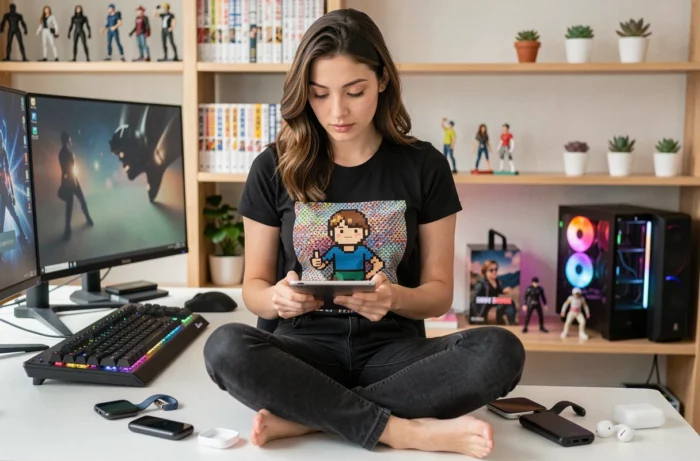
Women now represent half of the people who play video games in France. They buy smartphones, test audio headsets, set up PCs, and follow tech news with as much enthusiasm as any other audience. The female geek universe is no longer just a marketing segment: it is a massive reality, driven by daily practices and active communities.
Regular female gamers: what recent figures change in the portrait of the geekette
You may have heard the idea that women are “casual” gamers, confined to mobile games? Recent data clearly contradicts this. According to a SELL/Médiamétrie study for 2025, adults make up 88% of the gaming population in France, and more than three-quarters play at least once a week.
What stands out is the regularity. Women are among the most dedicated profiles, far from the cliché of a Candy Crush session on the subway. They invest time in a variety of titles: narrative RPGs, cooperative survival games, management simulations. Geekette Inside precisely documents this diversity of practices, including hardware testing, game reviews, and monitoring tech news.
The gap persists elsewhere. Research published by EDHEC at the end of August 2026, covering 160 games released between 1988 and 2025 (representing 1.4 billion copies sold), shows that less than 2% of titles achieve gender parity in their representation of characters. Female gamers are present, but female characters remain a minority on screen.
Women in the video game industry: a concerning decline
The paradox deserves attention. On the usage side, parity is almost achieved. On the creation side, the trend is moving in the opposite direction.
Data from Women in Games France, relayed in the EDHEC study, indicates that the share of women in French studios has fallen to 20%, a loss of four points in three years. This decline affects both technical positions (programming, game design) and artistic or production roles.
Why this gap? Several factors accumulate:
- Training pathways in computer science and game design remain unbalanced, with the proportion of female graduates stagnating for several years.
- Working conditions in some studios (crunch periods, culture of constant availability) discourage profiles that do not fit the historical model of the always-available male developer.
- The lack of representation in leadership positions creates a mirror effect: it is difficult to envision oneself in a profession when visible role models are rare.
This observation is not limited to video games. The entire tech sector in Europe shows similar proportions for software engineering or artificial intelligence research positions.
High-tech testing for women: going beyond the “for women” category
When a manufacturer launches a product labeled “for women,” it often involves a color change and a thinner strap. The product remains technically identical, sometimes even with fewer features, for an equivalent or higher price. This phenomenon has a name in commerce: the “pink tax.”
Geek media led by female writers approach the issue differently. Rather than categorizing products by gender, they evaluate what really matters: the ergonomics for smaller hands on a gaming mouse, the comfort of a headset on different head shapes, the relevance of an integrated menstrual cycle tracker in a smartwatch.
Some concrete criteria that come up in tests aimed at this audience include:
- The actual size and weight of the product, measured and compared to the average size of female hands or wrists, rather than a vague mention of “compact.”
- The reliability of specific health sensors (hormonal tracking, stress detection) compared to dedicated apps already available on smartphones.
- The actual value for money, comparing the “female” model to its mixed equivalent when available.
This technical and non-condescending approach attracts an audience that far exceeds the female demographic. A good tech product review has no gender, but it benefits from considering the diversity of body types and uses.
Geek culture and female representation: what is changing in content
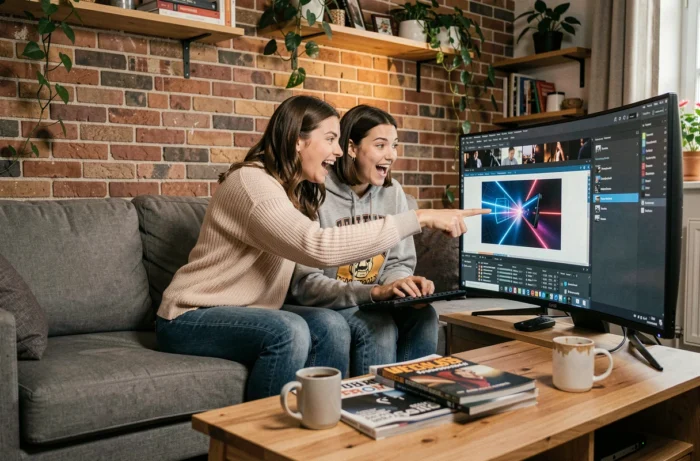
Geek culture is not limited to hardware. Series, films, comics, manga: complex female characters are multiplying in recent productions. This movement is not cosmetic. It responds to audience demand and a growing awareness among creators.
Streaming has accelerated the changes. Platforms are funding projects with heroines who do not merely serve as support roles or love interests. Audiences are following, and engagement data shows that this content performs just as well, if not better, than traditional formats.
On Twitch and YouTube, female content creators in gaming and tech are gaining visibility. Their communities are structuring, with moderated discussion spaces that allow for technical exchanges without harassment. Active moderation remains the key factor for the sustainability of these spaces: without it, toxic comments quickly drive away newcomers.
The progress made is real. The practice statistics confirm this. On the industry and representation side, however, the balance has not yet been achieved. The gap between the mass of female gamers and tech consumers on one side, and their presence in creative teams on the other, remains the most concrete point of friction to watch in the coming years.