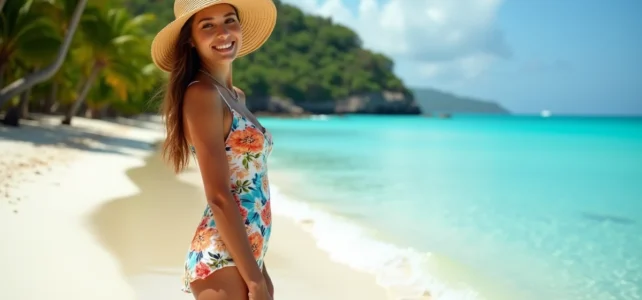
In Guadeloupe, the sun rises early and sets early. The duration of the day varies between eleven and twelve hours depending on the season, a small difference compared to mainland France. This tropical rhythm influences how locals and visitors organize their time on the coast, much more than traditional guides focused on beach selection suggest.
Free access and municipal regulations: what really governs the beaches in Guadeloupe
The vast majority of Guadeloupean beaches are freely accessible without closing hours. No gate closes at 6 PM, and no guard asks you to leave the sand at a fixed time. Only a few coastal areas linked to hotels or private clubs impose specific access times.
Further reading : Everything You Need to Know About the Different Types of Central Processing Units in Computing
This framework of free access does not mean the absence of regulation. In the municipality of Gosier, the local government and the prefecture can modify swimming conditions reactively, by decree, based on water quality or health incidents. In 2026, the Gosier town hall lifted a swimming and water activity ban on five beaches in the municipality, information relayed by France-Antilles and RCI.
In practice, before settling on a beach in Gosier or another municipality, check if a recent municipal decree restricts swimming. These decisions can change from one week to the next. Understanding the beach hours in Guadeloupe depends as much on the weather as on this type of local regulatory constraint.
See also : Everything You Need to Know About the Maximum Amount for a Joint Guarantee in Real Estate Rental
Time slots and attendance: when to lay your towel on Guadeloupean beaches
The sun rises around 5:30 to 6 AM depending on the time of year, and sets between 5:30 and 6:45 PM. This short range compared to a metropolitan summer changes the organization of the day.
In the morning before 10 AM, the most comfortable slot
For very popular beaches like Petit Havre in Gosier, Guadeloupean media recommend arriving before 10 AM for parking and shade. At this hour, the coconut trees still cast enough shade, the temperature remains bearable, and the parking lots are not crowded.
This morning slot is also when the UV index remains moderate. Between 10 AM and 2 PM, radiation peaks under these Caribbean latitudes, a factor that many visitors underestimate.
In the afternoon and the weekend trap
Avoid the mid-afternoon on weekends at popular beaches in Grande-Terre is common sense. Guadeloupean families flock to the beaches of Sainte-Anne and Gosier starting Saturday noon. The white sand and turquoise waters of Caravelle or Bois-Jolan fill up quickly.
During the week, the situation is different. A time slot between 3 PM and 5 PM offers softer light, reduced attendance, and pleasant water temperature.
UV radiation and sun protection on the Guadeloupean coast
The proximity to the equator places Guadeloupe in a zone where the UV index regularly exceeds the very high threshold between 10 AM and 3 PM. This is not a cosmetic detail: severe sunburn can occur in just a few minutes on white sand that reflects radiation.
Several reflexes can help limit risks without giving up the beach:
- Favor beaches bordered by vegetation (almond trees, coconut trees) that offer natural shade, such as Petit Havre or the beach in the village of Sainte-Anne
- Plan water activities (snorkeling, kayaking, diving) early in the morning or late in the afternoon, when the sun is lower on the horizon
- Keep in mind that the trade winds, constant in Guadeloupe, mask the sensation of heat without reducing UV exposure
Differences between Grande-Terre and Basse-Terre: the sun is experienced differently
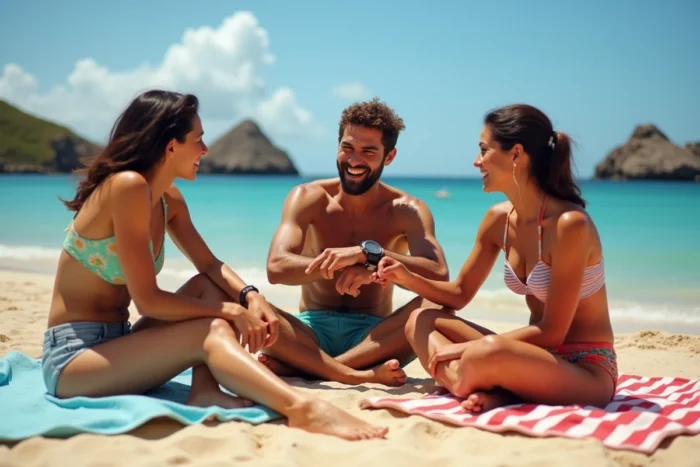
Grande-Terre, flat and limestone, concentrates white sand beaches and turquoise lagoons. Sunshine is maximal there, and coastal vegetation is less dense. The beaches of Sainte-Anne, Saint-François, and Gosier receive full sun from the morning.
Basse-Terre presents an opposite profile. The volcanic relief generates microclimates with more frequent showers, especially in the afternoon on the windward coast. The black sand beaches (Malendure, Grande Anse in Trois-Rivières) benefit from a more shaded setting thanks to the tropical forest in the background.
For a visitor looking to maximize sun time, Grande-Terre offers more weather guarantees. However, those who struggle with intense heat will find on Basse-Terre a more temperate coastline, where the timing question arises differently: the morning remains dry and sunny, while the afternoon often brings showers.
Dry season or wet season: the concrete impact on beach hours
Guadeloupe experiences two seasons. The dry season, called carême, runs from December to April. The wet season, called hivernage, extends from June to November.
During carême, days offer almost continuous sunshine. Showers are rare and brief. The question of hours then boils down to managing attendance and UV radiation.
During hivernage, the pattern changes:
- Mornings generally remain sunny until 11 AM or noon
- Tropical showers tend to fall in the early or mid-afternoon, sometimes heavy but short
- The end of the day (after 4 PM) often becomes clear again, offering a second usable beach slot
Field reports vary on this point depending on the years and geographical areas. A day of hivernage in Grande-Terre can remain dry while Basse-Terre receives several successive showers.
Adapting beach hours in Guadeloupe is not limited to checking the time of sunrise and sunset. The municipality, the season, the day of the week, and any health decrees weigh as much as the sun’s position in the sky. Checking local conditions on the morning itself, before loading the trunk, remains the most reliable precaution.