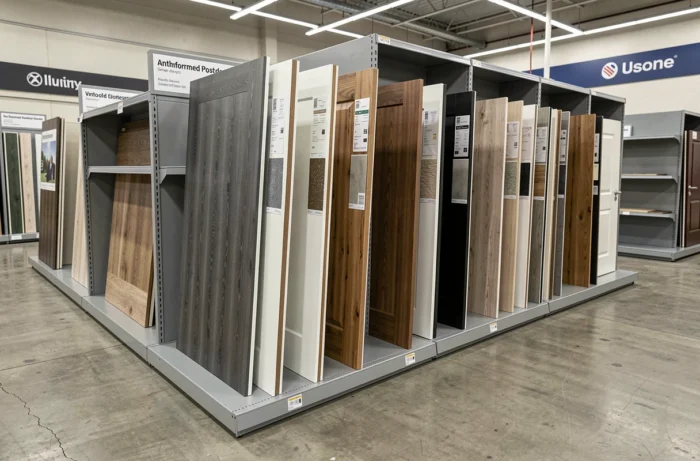
When you push open the door of a DIY store, postformed models often occupy an entire aisle. Their smooth surface, without molding or apparent relief, makes them recognizable at first glance. Choosing a postformed door involves understanding what lies beneath this shell and identifying the criteria that will make a difference in daily use, both in terms of durability and visual appeal.
Postformed door: what the press manufacturing hides
The postforming technique consists of wrapping a rigid core (often honeycomb cardboard or particle board) with a heated melamine resin sheet under pressure. The coating conforms to the edges of the panel and creates a rounded profile on the edges, without a visible joint.
This process results in a perfectly smooth and homogeneous surface. Unlike a wooden door whose moldings are machined from the mass, the relief of a postformed door is purely surface-level. The melamine sheet reproduces a pattern (wood grain, solid color, concrete effect) without any sculpted material underneath.
This point has a direct consequence: resistance to impacts remains modest. A localized impact can dent the coating if the core is honeycomb. For a heavily trafficked hallway or a child’s room, checking the density of the core before purchase changes the game. A tubular or solid particle board core withstands blows better than a standard honeycomb. You will also find Haussmannian chimney tips on Madmoizl Déco that detail these differences in internal structure.
Criteria for choosing a postformed door according to the room
Have you ever noticed that the bathroom door ages faster than the living room door? Humidity, frequency of passage, and the need for sound insulation vary from room to room. Three criteria deserve special attention.
Thickness and density of the core
The majority of postformed doors come in two common thicknesses. The thinner model is suitable for closets or secondary rooms. For a bedroom or an office, prefer the thicker option: it better attenuates noise and offers better durability over time.
Moisture resistance
Standard melamine does not handle standing water well. In a bathroom or laundry room, a postformed door with a treated waterproof coating prevents swelling of the edges. Check the mention on the technical sheet: some manufacturers offer specific treatment for the lower edges, the area most exposed to splashes.
Direction of opening and frame size
Measure the existing frame before placing any order. Postformed doors come in both left and right opening, as well as sliding versions. A common mistake is to choose the model without checking the actual passage width, which may differ from the catalog measurement by a few millimeters.
- Most common standard width: suitable for most classic residential frames, but older buildings often have slightly non-standard measurements.
- Height: some manufacturers offer taller doors for generous ceilings, which also changes the weight and necessary hardware.
- Thickness of the frame: a frame that is too narrow requires the installation of insulation strips, an extra cost to anticipate.

Finishes and decor tips for postformed doors
The main complaint about postformed doors is their generic appearance. Smooth white, lacking character. This observation is justified for entry-level models, but there are several levers to personalize the result without breaking the budget.
Color and surface decor
The choice of melamine decor sets the entire ambiance of the room. Catalogs now offer light oak, walnut, anthracite gray, or even pastel shades. A wood decor in a hallway creates continuity with a floor, while a matte white remains the most neutral choice for a contemporary interior.
Another option: paint the door after installation. Melamine accepts paint as long as you lightly sand the surface and apply an appropriate primer. Without this preparation, the paint will peel within a few months.
Hardware as a style element
Changing the handles visually transforms a basic door. A brushed brass handle on a white panel, for example, adds a contrast that melamine alone cannot offer. Invisible hinges enhance the clean look of the postformed door by eliminating any protruding elements on the edge.
- Round rose handle: discreet, suitable for minimalist interiors.
- Long plate lever handle: more classic style, it covers any traces of the old lock when replacing.
- Rotary knob: reserved for closet or dressing room doors where a lock is not necessary.
Postformed door or isoplane: what is the concrete difference on the wall
Both types of doors share a similar price range and a lightweight structure. The real distinction lies in the edge profile. The isoplane door features straight, sharp edges with an added veneer. The postformed door rounds its edges thanks to the continuous coating, which eliminates the visible joint on the edge.
In terms of design, the isoplane integrates better into a very geometric interior where every line is sharp. The postformed door, with its softened edges, produces a softer effect, sometimes perceived as less contemporary. Neither offers remarkable sound insulation: for a real acoustic gain, one must move up to higher-end doors with solid cores or certified door blocks.
The choice is therefore primarily based on aesthetic appeal and ease of maintenance. The continuous melamine of the postformed door can be cleaned with a sponge without the risk of peeling off an added edge, making it a good candidate for rental properties or high-traffic areas.