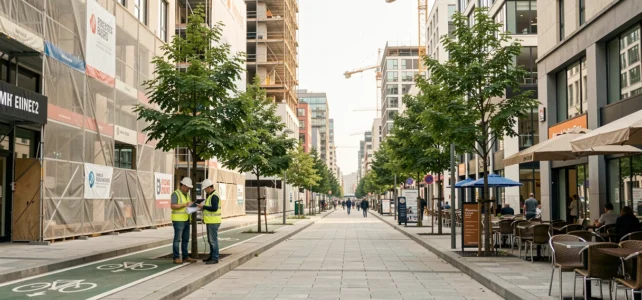
For several years, the former industrial axes of medium-sized cities and metropolitan areas have concentrated an increasing share of urban renewal operations. The Climate and Resilience Law, with its goal of zero net land take (ZAN), has imposed a strict framework: any new opening to urbanization must be preceded by an analysis of the potential for densification in already urbanized areas.
The new programs emerging along avenues historically dedicated to industry are part of this land recycling logic, rather than expansion.
Recommended read : Discover how to navigate easily with the complete Refair sitemap
Change of use and land recycling: what the recent legal framework concretely allows
The legal framework applicable to the conversion of industrial wastelands has significantly evolved. Recent texts facilitate changes of use for unoccupied artificialized land, a lever awaited by developers who previously faced lengthy procedures to transform a logistics site or an old warehouse into a residential or mixed-use program.
New categories of development operations are now designed for land recycling. Local authorities have tools to integrate the conversion of industrial plots directly into their urban planning documents, without going through a complete revision of the local urban plan (PLU). In practice, the transformation of offices into housing also benefits from simplifications introduced by this same legislative wave.
You may also like : How to Optimize the Use of Online Chat Platforms: Key Tips and Tricks
The tightening of post-ZAN planning reasoning has direct consequences on the avenue of industry and its new programs: operators wishing to build must prove that no recyclable land is available before considering urban expansion. This mechanism mechanically favors projects located on former industrial sites, already served by networks.

Technical barriers on industrial wastelands: soil pollution and decontamination costs
The legal tools do not eliminate physical obstacles. The conversion of an industrial site almost always requires a soil pollution assessment, followed by decontamination work whose cost can represent a significant part of the overall budget for the operation.
Several types of constraints accumulate on these sites:
- The presence of pollutants (hydrocarbons, heavy metals, solvents) necessitates in-depth soil studies and appropriate treatment techniques, which extends the timelines by several months before construction can begin.
- Existing networks (water, sanitation, electricity) are often outdated or undersized to accommodate mixed-use programs that include housing, shops, and public spaces.
- Land fragmentation complicates negotiations: a single avenue may have multiple private owners, co-owned plots, and areas belonging to public institutions, making land control lengthy and costly.
Field feedback varies on the actual capacity of local authorities to absorb these additional costs. Some metropolitan areas have public land establishments capable of bearing the financial risk during the decontamination phase. In contrast, medium-sized cities, which are less endowed, struggle to mobilize the necessary resources without state or Territorial Bank subsidies.
New programs on former industrial sites: what changes for the neighborhood
When a renewal operation succeeds, it profoundly alters the surrounding urban fabric. A new program located on an industrial wasteland brings residential density to already artificialized land, which meets both housing demand and ZAN objectives.
The impact on the neighborhood goes beyond just the residential aspect. The specifications for recent operations generally impose a functional mix: housing, artisanal activities, and local shops. This requirement aims to avoid the creation of dormitory neighborhoods, a common pitfall of programs from previous decades.
Infrastructure and public spaces as conditions for success
The quality of access infrastructure conditions the attractiveness of the program. An axis like an avenue of industry often benefits from a significant width, inherited from its logistical past. This characteristic allows for the integration of bike lanes, public transport on dedicated routes, and green spaces without reducing the buildable area.
The Action Cœur de Ville program, led by the National Agency for Territorial Cohesion (ANCT), illustrates this approach. The ANCT and its partners (Territorial Bank, ANAH, Action Logement, local authorities) mobilize substantial funding to restore the attractiveness of medium-sized city centers. Initial results show an increase in foot traffic and the number of rehabilitated shops in the affected areas.

Taxation and public aid in 2025-2026: what levers to accelerate conversions
The France 2030 plan allocates a portion of its budget to finding solutions for sustainable cities and innovative buildings. Part of this funding directly supports projects for the conversion of wastelands, through targeted calls for projects focused on land efficiency and energy performance.
Tax incentives are also evolving. The Official Bulletin of Public Finances has clarified the application methods for certain advantages related to land recycling operations. Developers can, under certain conditions, benefit from partial exemptions when transforming an industrial site into a mixed-use program.
The available data does not yet allow for measuring the cumulative effect of these new tools on the actual pace of conversions. The first projects launched under recent legislative regimes are still in the study phase. The gap between the adoption of a text and the delivery of a new program spans years, making any evaluation premature.
A trade-off between speed and urban quality
The temptation to overly simplify procedures to accelerate constructions clashes with an imperative for quality. Feedback on urban renewal operations shows that the most successful programs are those that involve residents from the design phase. The European cities studied by La Fabrique de l’industrie (Bergamo, Ghent, Vitoria-Gasteiz) confirm that reconciling industrial needs and sustainable land management requires finely adapting tools to local conditions.
The development of new programs on former industrial avenues is gradually reshaping the city, neighborhood by neighborhood. The toolbox has expanded, funding exists, but success depends on the local capacity to coordinate decontamination, land control, and consultation. The next deliveries, expected within two to three years, will provide the first concrete elements of response.