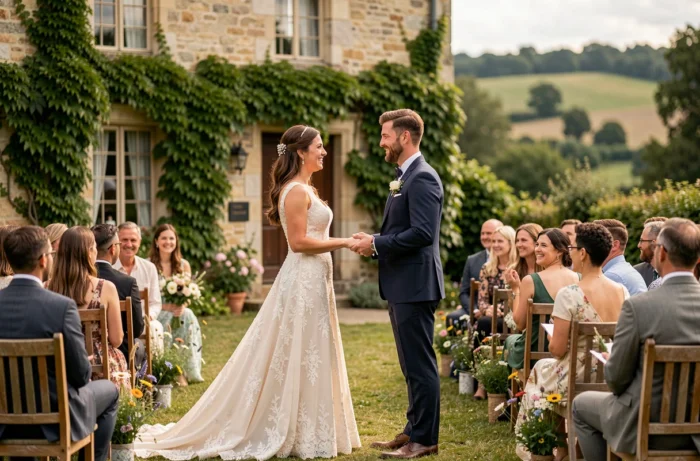
Organizing a wedding typically involves an average of ten distinct budget items, each subject to variables of seasonality, location, and number of guests. Comparing these items allows you to identify where the most frequent overruns occur and which decisions made early in the process condition the rest of the preparations.
Budget distribution by item: where the money really goes
Most guides list categories of expenses without showing their relative weight. The table below summarizes the usual hierarchy of items, ranked in descending order of budget share, as derived from specialized planning tools.
| Item | Estimated share of total budget | Main variable |
|---|---|---|
| Venue | The highest | Region and season |
| Catering / meals | Second item | Number of guests |
| Photography / video | Intermediate item | Duration of service |
| Floral decoration | Intermediate item | Theme and volumes |
| Attire (dress, suit) | Variable item | Designer choice or ready-to-wear |
| Entertainment / music | Variable item | DJ, band, or both |
| Stationery / invitations | Minor item | Quantity and finishes |
The venue and catering alone capture the majority of the budget. Budget overruns remain a structural phenomenon among couples in 2025-2026, according to the tools and studies cited by specialized sites. The most common reason: an underestimated number of guests at the outset, which mechanically inflates the catering bill.
A couple that locks in their guest list and venue very early stabilizes more than half of their total budget. All other decisions then become secondary adjustments.
To structure this budgeting phase, the resources from Univers Mariage provide a detailed overview of the items to anticipate and the service providers to compare.

Marriage administrative file: the documents that really block things
Classic guides mention the submission to the town hall without detailing the cases where the file becomes complicated. For couples with a foreign element (nationality, birth outside France), the documentary requirements increase significantly.
- A foreign birth certificate requires an apostille or legalization, depending on the country of origin, followed by a sworn translation. This process can take several weeks.
- The town hall may require a certificate of custom issued by the consulate of the country of origin, attesting to the marital capacity of the future spouse.
- In case of doubt about the validity of the file, the mayor can refer the matter to the public prosecutor for additional verification, which suspends the publication of the bans and postpones the ceremony date.
A decision commented on in August 2026 (the Chessy case, reported by Le Courrier de France) reminded that a mayor cannot refuse a marriage solely based on the residency status of a future spouse. Refusal is only legal in strictly regulated cases, with prior hearing and formalized procedure.
Preparing the administrative file at least four months before the desired date prevents delays in legalization from disrupting the entire timeline.
Choosing the venue: what makes the cost vary from simple to triple
The venue absorbs the largest portion of the budget, but not all venues charge the same for the same service. Three parameters explain most of the discrepancies.
Seasonality and day of the week
A wedding on a weekday or off-season (October to March) costs significantly less than a Saturday in June. The availability of service providers is also better, providing more room for negotiation on each quote.
All-inclusive package or dry venue
A castle or estate that mandates its caterer operates on a global package, often easier to manage but less flexible on unit costs. In contrast, a “dry” venue (rental only) allows the couple to freely choose each service provider, at the cost of heavier coordination.
A dry venue can reduce the overall bill, provided that additional management time is dedicated. For a couple working full-time, this time has a real cost that must be factored into the comparison.
Capacity and distance
A venue too large for the number of guests creates a feeling of emptiness, while a venue too small generates discomfort. The ideal gap is around the actual capacity of the guest list, without excessive margin. The distance between the ceremony venue and the reception venue influences transportation costs and guest fatigue, two factors often underestimated in planning.

Wedding timeline: the milestones that condition everything else
An effective timeline is not just a list of tasks organized by month. Some decisions, made too late, create a domino effect on all preparations.
- Booking the venue and caterer determines the date and number of guests. These two choices must be locked in at least a year before the big day.
- The choice of photographer and officiant (for a secular ceremony) directly depends on the chosen date. The most sought-after professionals are booked well in advance.
- Sending out invitations, which may seem secondary, sets the response deadline for guests and thus the final confirmation of the number of covers with the caterer.
The classic trap is delaying the finalization of the guest list. This delay impacts the seating plan, catering quantities, stationery, and accommodations to be reserved for distant relatives.
Marriage contract and matrimonial regime: an often-overlooked angle
The Higher Council of Notaries recently made proposals to adapt matrimonial regime law to the realities of current couples. This approach highlights a point that wedding planning guides overlook: the choice of matrimonial regime has lasting patrimonial consequences, well beyond the day of the ceremony.
Without a specific contract signed before a notary prior to the celebration, the couple is automatically subject to the legal regime of community property. For couples where one spouse is self-employed or owns real estate, a visit to the notary before the wedding allows for tailored protection for each party.
This notarial appointment should be scheduled several weeks before the civil ceremony, as the contract must be mentioned in the marriage certificate. Integrating it into the timeline from the initial phase prevents last-minute rush on a subject that deserves careful consideration.