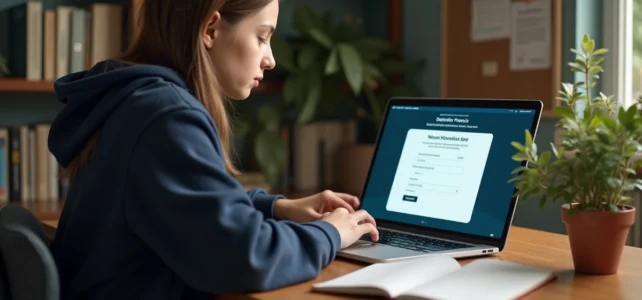
A high school senior opens Cyclades for the first time in October and encounters a lengthy form, vague drop-down menus, and an account to create before even selecting their exams. Wasting time at this stage risks missing the registration window, which lasts only a few weeks. Here we detail the concrete steps, from creating a candidate account to receiving results.
Creating a Cyclades account without technical issues
Before any registration, one must have an active account on the Cyclades portal. There are two methods: logging in via FranceConnect or using the platform’s native form. The choice is significant, as once the method is chosen, it must be used for all subsequent logins.
Read also : Everything You Need to Know About Beach Hours in Guadeloupe to Enjoy the Sun
FranceConnect simplifies data entry (name, surname, date of birth pre-filled), but assumes that the candidate or their legal representative already has an identifier on a partner service (impots.gouv, Ameli, etc.). The classic form requires more manual fields, including a postal address and a valid email address. It is recommended to check access to this email account before starting: the activation link expires quickly.
To better understand the steps for the 2026 baccalaureate on Cyclades, it is useful to know that creating the account and the registration itself are two distinct actions, sometimes separated by several days.
You may also like : Everything You Need to Know About ISOE: Definition, Usefulness, and Functioning for Professionals
A common trap: independent candidates who have never had a school account think they can register directly. They must first go through the account creation step and then wait for email validation. Feedback on the reception time varies, ranging from a few minutes to several hours depending on server load.
Registration for the 2026 baccalaureate: what Cyclades really requires
Once logged in, the candidate accesses the “My registrations” section. For the general baccalaureate session 2026, the platform requires filling in several blocks of information in a specific order.
- The choice of the registration academy, which determines the exam center and the exact dates of the convocations. A candidate enrolled in a public institution sees this information pre-filled, but an independent candidate must manually select their academy of residence.
- The specialty subjects taken in the final year (two subjects), as well as any optional subject. This choice affects the schedule of the final exams and the coefficients applied.
- The registration regime: school (via the institution), individual (independent candidate), or CNED. Each regime has its own rules for validation and submission of the file.
Continuous assessment counts for 40% of the final grade, calculated from the annual averages of the first and final years. The final exams account for the remaining 60%. This distribution is stabilized for the 2026 session.
Pay attention to detail: the platform may display specialty subjects that do not correspond to those taken by the candidate if the profile has not been correctly filled out by the institution. In this case, it is necessary to contact the exam secretariat of the academy before the registration deadline.
Final exams and the 2026 baccalaureate calendar
The exam calendar follows a sequence that Cyclades reflects in the candidate space once registration is validated. The early French exams concern first-year students, while final-year students take philosophy, the two specialties, and the Grand oral.
A candidate scoring below 8/20 after the final exams cannot access the retake, even by jury decision. This threshold, confirmed in the official texts for the 2026 session, changes the game for students who were counting on the retake oral exams as a safety net.
Convocations and exam location
The convocation can be downloaded from Cyclades a few weeks before each exam. It specifies the location, time, and documents to present (identity document, printed convocation). Independent candidates must regularly check their space, as no postal notification is systematic.
For the written specialty exams, the schedules may vary from one academy to another. It is advisable to check the convocation as soon as it is online to anticipate travel, especially when the exam center is far from home.

Results of the 2026 baccalaureate and retakes on Cyclades
Results are published on Cyclades on a date set by each academy, usually in early July. The report card details the results by subject, with the coefficients applied and the overall average.
New for the 2026 session: the components of the science exam appear separately on the report card, no longer under a single overall score. This change allows the candidate to better identify their strengths and weaknesses by scientific discipline.
Retake Orals: How It Works
A candidate who scores between 8 and 10/20 in the overall average can access the second group exams. On Cyclades, the subjects eligible for retake and the schedules are displayed in the candidate space after the publication of results. The candidate chooses two subjects from those presented in the final exams.
Only the best score between the written and oral is retained for each subject retaken. Therefore, there is no risk in attempting the oral, even in the case of average performance.
The final report card, including any retakes, is then downloadable from the platform. This document is valid for registrations in higher education via Parcoursup. Keeping a digital and paper copy remains a basic precaution, as access to Cyclades may be restricted after the session closes.