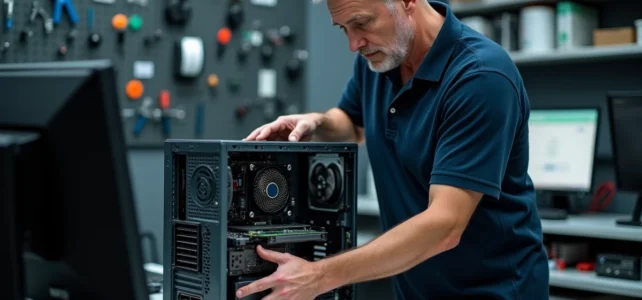
The central unit is not just the case sitting under a desk. Depending on the target segment, the internal design, format, and thermal considerations change radically. Today, we distinguish several families of central units whose boundaries blur as uses converge towards mixed workloads: computing, graphic rendering, local AI inference.
Thermal architecture and TDP: the criterion that product sheets hide
The TDP (Thermal Design Power) conditions the actual behavior of a processor in a central unit. Two CPUs displaying the same base frequency do not deliver the same performance if the thermal envelope differs. A full-size tower case tolerates a high TDP thanks to generous airflow, while a compact mini-PC throttles the processor under sustained load.
Read also : Everything You Need to Know About Beach Hours in Guadeloupe to Enjoy the Sun
We observe that the chassis format dictates the actual performance of the CPU. A desktop Intel Core on an LGA 1700 socket in an ATX tower utilizes its entire thermal envelope. The same processor, offered in a low-power “T” version for a compact format, loses a significant portion of its multi-core performance.
To delve deeper into the distinctions between chassis and components, the definition of a computer central unit on Lozzoo details common configurations and their hardware specifications.
See also : Everything You Need to Know About the Maximum Amount for a Joint Guarantee in Real Estate Rental
The motherboard plays a direct role in this equation. On an ATX format, the power stages (VRM) have more phases, which stabilizes the voltage under load and allows for sustainable overclocking. On a Mini-ITX board, the thermal compromise imposes more compact VRMs, which are less tolerant of consumption spikes.
ATX, Micro-ATX, and Mini-ITX: three central unit formats, three logics
The choice of case format determines the machine’s scalability. The ATX tower remains the reference for gaming and workstation configurations. It accommodates long graphics cards, multiple SSD or HDD storage drives, and a large CPU cooler.
The Micro-ATX reduces footprint without completely sacrificing modularity. We recommend this format for an office or multimedia workstation that could later receive a dedicated graphics card. RAM remains expandable across four slots in most cases.
The Mini-ITX pushes compactness to the extreme: a single expansion slot, two memory slots, limited storage space. This format is suitable for reception desks in companies or HTPCs (Home Theater PCs). It requires selecting a processor with a moderate TDP and a low-profile cooling system.
- ATX Tower: maximum scalability, efficient cooling, significant floor space
- Micro-ATX: compromise between size and modularity, compatible with most mid-range GPUs
- Mini-ITX: ultra-compact, reduced consumption, very limited expansion capability
Mini-PCs and compact central units: the rise in the professional sector
Mini-PCs are gaining ground in companies. Call centers, reception desks, meeting rooms: the space-saving and reduced energy consumption motivate this adoption. A manufacturer like GMKtec now offers mini-PCs the size of a gaming console with memory capacity reaching 128 GB of RAM dedicated to local AI inference.
This trend reflects a paradigm shift. The central unit is no longer necessarily a bulky case. For light data processing, video conferencing, or office tasks, a mini-PC equipped with an NVMe SSD and a low-power processor offers responsiveness equivalent to that of a traditional tower.
The limit remains the GPU. Without a physical PCIe x16 slot, these machines rely on the integrated graphics circuit of the processor. For gaming or 3D rendering, the tower remains the only real alternative.
Central unit for gaming: GPU, RAM, and SSD storage as the decisive trio
The graphics card absorbs the majority of a gaming central unit’s budget. We recommend allocating at least half of the total budget to the GPU. A recent mid-range processor (six to eight cores) is sufficient for the vast majority of current games, provided it does not create a bottleneck with the chosen graphics card.
RAM stabilizes around two sticks in dual-channel. NVMe SSD storage reduces loading times but does not improve framerate in games. Investing in a faster SSD than PCIe Gen 3 only has measurable benefits for video editing or handling large files.
- Processor: six to eight cores are sufficient for gaming, single-core performance matters more than the number of threads
- GPU: the most determining component, sized according to the target resolution (1080p, 1440p, 4K)
- RAM: two identical sticks in dual-channel, the standard capacity today is sufficient for most titles
- NVMe SSD: a Gen 3 model covers gaming needs, Gen 4 or Gen 5 is justified for creative workflows

Durability and scalability: CSR criteria for choosing a central unit
Recent buying guides now incorporate repairability and sustainable scalability criteria into the evaluation of central units. A modular tower where the processor, RAM, and storage can be replaced individually extends the machine’s lifespan by several years.
Closed formats (proprietary cases, soldered components) reduce this flexibility. We find that companies and individuals aware of the carbon footprint of digital technology prefer high-efficiency power supplies (80 PLUS Gold certification or higher) and low-power components.
Favoring a modular tower over a closed format remains the most direct lever to reduce hardware renewal. An ATX or Micro-ATX chassis accommodates several generations of processors if the motherboard supports a BIOS update, which avoids replacing the entire system with each technological cycle.
The choice of a central unit commits for several years. Whether the priority is gaming, productivity, or energy efficiency, it is the match between the case format, the processor’s thermal envelope, and the expansion capability that determines the relevance of an investment.