
Between a garden treated with synthetic products and an organic garden, the differences in yield, cost, and biodiversity are not always what one might imagine. Ecological gardening relies on measurable mechanisms: soil fertility, crop rotation, water management. This article compares conventional and organic practices in the garden to identify what truly makes a difference in an organic garden.
Living soil versus chemically amended soil: a comparison of approaches in the garden
The soil is the central variable of ecological gardening. Two opposing strategies exist: feeding the plant directly (synthetic fertilizers) or feeding the soil so it can nourish the plant (compost, mulching, green manures). The table below summarizes the concrete differences.
See also : How to Choose and Use an Electric Hedge Trimmer for Your Garden
| Criterion | Conventional garden | Organic / ecological garden |
|---|---|---|
| Source of fertility | Mineral fertilizers (NPK) | Compost, manure, green manures |
| Microbial life of the soil | Depleted in the medium term | Stimulated by organic matter |
| Mulching | Rarely practiced | Systematic (straw, wood chips, leaves) |
| Watering needs | High (bare soil, evaporation) | Reduced thanks to mulching and soil structure |
| Annual input cost | Regular purchase of fertilizers and pesticides | Almost zero after setting up the composter |
| Impact on pollinators | Negative (insecticides) | Positive (floral diversity, absence of toxins) |
The most striking difference concerns soil life. A mulched and composted soil retains water better and is easier to work than bare soil receiving chemical inputs. Mulching alone significantly reduces evaporation in summer.
To choose the right tools for working the soil without deep tilling, specialized resources like grelinette-warrior.com detail the characteristics of tools suited for organic gardening.
Recommended read : What budget to plan for expanding your home? Estimation and practical tips
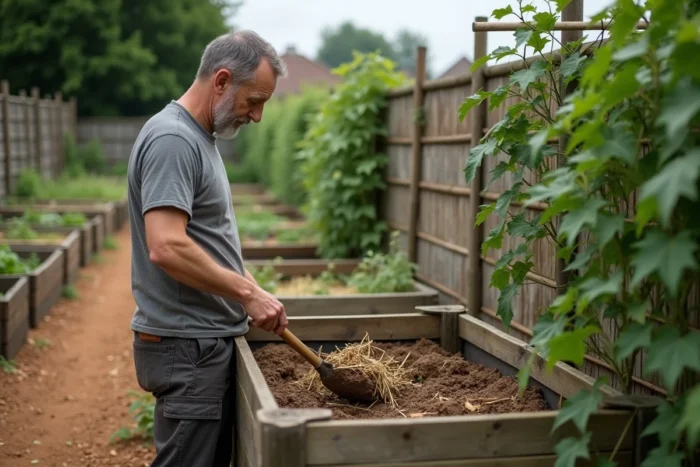
Crop rotation and plant associations in the organic garden
Crop rotation is the least visible pillar of the ecological garden, but its effect on yields is clear. Growing the same family of vegetables in the same spot for several years depletes specific nutrients and encourages the accumulation of pathogens in the soil.
Why alternate botanical families
Nightshades (tomatoes, peppers, eggplants) are nitrogen-hungry. Legumes (beans, peas, broad beans) fix atmospheric nitrogen in the soil through their root nodules. Following a crop of tomatoes with beans naturally restores fertility without external inputs.
Cucurbits (zucchini, squash) prefer soil rich in fresh organic matter. Alliums (garlic, onion, leek) are less demanding and help to sanitize the soil. Alternating these four families across four plots creates a self-sustaining cycle.
Plant associations that work
Not all plant associations are equal. Some are based on documented mechanisms, while others are more rooted in tradition.
- Tomato and basil: basil attracts beneficial pollinators, and some gardeners observe a reduction in aphids nearby
- Carrot and leek: each repels the other’s pest fly (carrot fly, leek moth), a well-documented interaction
- Corn, climbing bean, and squash (the “three sisters”): corn serves as a support, beans fix nitrogen, and squash covers the soil and limits weeds
- Aromatic plants at the edges (lavender, thyme, sage): they provide protection to neighboring crops against certain pest insects
Plant associations reduce the need for treatments, even biological ones. A diverse garden naturally attracts beneficial insects (ladybugs, hoverflies, lacewings) that regulate aphid populations.
Water management in the ecological garden: mulching and conservation techniques
Watering is the most time-consuming task in the garden during summer. Ecological gardening aims to reduce this dependency through three complementary levers.
Organic mulching (straw, dead leaves, dried grass clippings) is the first lever. Applied at a sufficient thickness, it limits evaporation, maintains soil freshness, and nourishes earthworms as it decomposes. Mulching your garden from the time of planting significantly reduces the frequency of watering compared to bare soil.
The second lever is the timing of watering. Watering early in the morning or in the evening reduces losses due to evaporation. Watering at the base (watering can, drip irrigation) is preferable to spraying, which wets the foliage and promotes fungal diseases.
The third lever concerns rainwater harvesting. A collector connected to a gutter allows for storing a significant volume for dry periods, without energy costs.
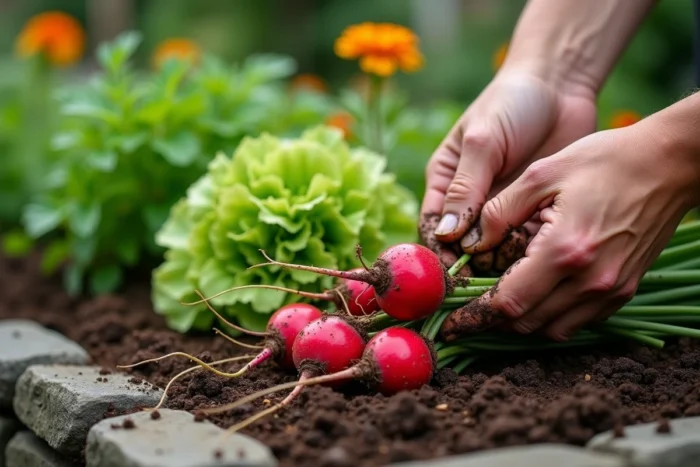
Compost and green manures: creating your own fertility without buying inputs
Home composting transforms kitchen and garden waste into an amendment rich in microorganisms and assimilable nutrients. A well-managed composter produces mature compost in a few months.
Compost replaces both fertilizer and soil amendment. It improves the structure of both clay and sandy soils, making it the most versatile tool for the organic gardener.
Green manures (mustard, phacelia, clover) complement compost. Sown on a resting plot, they cover the soil, prevent weed growth, and, once mowed and incorporated, return organic matter. Phacelia has the additional advantage of massively attracting pollinators during its flowering.
Biodiversity in the garden: a lever for natural pest regulation
An effective organic garden is not limited to vegetable beds. Hedges, flower strips, and areas left fallow play a direct role in pest regulation.
Leaving a corner of the garden with tall grasses provides habitat for ground beetles, predators of slugs. Installing an insect hotel or simply stacking a few drilled logs attracts solitary bees, which contribute to the pollination of zucchini and strawberries.
An ecological garden willingly embraces apparent disorder to build a biological balance. Nectar-rich flowers (borage, marigold, cosmos) sown between rows of vegetables create a mosaic favorable to beneficial insects.
Some French cities are now encouraging neighborhood urban gardens where the harvests are redistributed to solidarity grocery stores. The organic garden then goes beyond self-consumption to become a tool for local solidarity, an angle still little exploited by individual gardeners.
The data that best summarizes the interest of the ecological garden is that of the soil: a living soil, nourished with organic matter, becomes more fertile each year without paid external inputs. The virtuous circle of compost-mulching-rotation makes the system increasingly self-sufficient over time, whereas a conventional garden remains dependent on regular purchases.