
A baby who grabs their foot, who turns their head towards a familiar voice, who suddenly refuses the puree they loved the day before: each day brings its share of micro-evolutions. The well-being and development of a baby are not just about checking off milestones on a calendar. They are built through ordinary gestures, repeated exchanges, and sometimes in what seems to produce nothing at all.
Five interconnected areas of baby development, not an isolated checklist
You may have noticed that a baby who sleeps poorly often eats less well, and that a stressed baby babbles less? These links are not coincidences. The WHO now structures early development around five interdependent components, grouped under the term nurturing care: health, nutrition, attentive care, early learning, and protection.
In practical terms, this means that improving an infant’s sleep can have a direct effect on their ability to explore, respond to stimuli, and even on the quality of their interactions with their parents. Focusing on just one area while ignoring the others is like watering a plant without checking that it gets light.
Many resources allow for tracking these different aspects over the months. Parents looking for reliable benchmarks will find thematically organized content on futuremaman.fr for babies, with age-specific breakdowns that make daily reading easier.
Responding to baby signals: the most underestimated lever

We often talk about stimulation. Reading stories, offering developmental toys, singing nursery rhymes. All of this matters. But the contingent response to baby signals is more important than the quantity of stimulation.
Contingent response is a technical term for a simple gesture: when the baby points at an object, you name that object. When they look away, you understand they need a break. When they babble, you respond as if it were a real conversation.
This back-and-forth, sometimes called “serve and return interaction,” builds brain connections much more effectively than a musical mobile left on. The WHO also includes learning this parental posture in primary care: observing, talking, singing, playing, and responding are considered health-promoting actions in their own right.
When the parent is well, the baby benefits
Recent WHO frameworks recommend linking child development screening to psychosocial support for parents. The reason is logical: an exhausted, anxious, or isolated parent will have a harder time picking up on their baby’s subtle signals.
Parental mental health is part of baby well-being. It is not a secondary issue. Early support (support groups, postnatal follow-up, home assistance) benefits both the adult and the infant.
Sleep, nutrition, hygiene: three pillars of baby’s daily life
These three areas concentrate the majority of parents’ daily questions. Rather than listing generic advice, here are the points that deserve special attention.
Infant sleep: a rhythm that develops
A newborn’s circadian rhythm is not mature. It develops gradually over several months. Expecting a few-week-old baby to “sleep through the night” is asking them to do something their brain cannot yet produce.
A regular sleep environment helps the brain set its internal clock. The same signals before bedtime (dim lighting, bath, lullaby), the same place, the same sensory cues. Consistency matters more than technique.
Nutrition and diversification
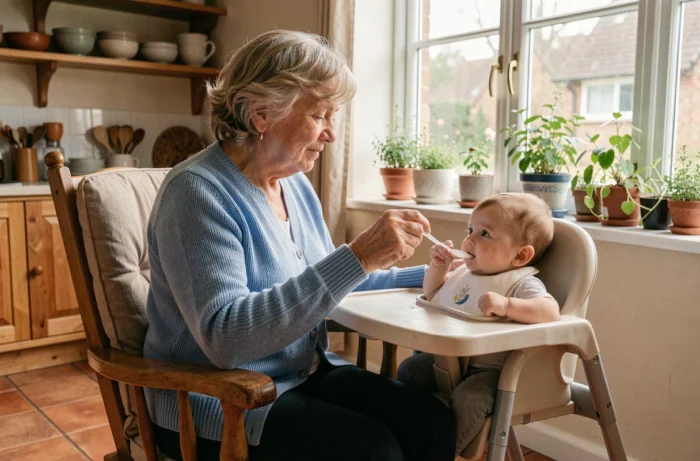
The transition from milk to solid foods is a moment of sensory as well as nutritional discovery. Here are some concrete guidelines:
- The first vegetables should be introduced one at a time, over several days, to give the baby time to get used to each taste and identify any potential reactions.
- The texture evolves gradually: smooth purees, then mashed, then soft chunks. The pace depends on each child, not a fixed calendar.
- Eating with fingers is not a whim: it is an exercise in fine motor skills and autonomy that contributes to overall development.
Baby hygiene and bath
Daily bathing is not a dermatological obligation. For infants, two to three baths per week are sufficient, supplemented by washing the face, hands, and bottom. Too frequent bathing can dry out a baby’s delicate skin.
The bath time serves another function: it is a rich sensory experience (contact with water, temperature, touch) and a relational ritual. Talking to the baby during the bath, naming body parts, playing with a cup of water, all of this nourishes their language and emotional development along with their hygiene.
Comfort object, familiar items, and baby’s emotional security
Around four to eight months, many babies become attached to a particular object: a comforter, a piece of fabric, a stuffed animal. This transitional object plays a specific role. It represents a stable reference point when the parent is away.
Here are some practical points often overlooked:
- Buying the comforter in duplicate from the start prevents a major crisis in case of loss. The baby recognizes the smell and texture, not the label.
- Wash the comforter regularly, but not systematically just before bedtime: the familiar smell is part of its reassuring function.
- Do not force a baby to adopt a comforter. Some children do not need one and find other soothing strategies (thumb-sucking, rocking, parental closeness).
The comforter is not a substitute for the parent but a temporary support that helps the baby manage separation. Its presence during transitions (daycare, bedtime, travel) facilitates adaptation.
The daily well-being of a baby relies less on purchases or programs and more on the quality of ordinary interactions. Observing their signals, respecting their rhythms, maintaining a flexible routine, and taking care of oneself as a parent: these are the most concrete levers, and those whose effects last the longest.